| Age | Commit message (Collapse) | Author | Lines |
|---|
|
Simple modification of `non_lifetime_binders`'s diagnostic information to adapt to type binders
fixes #119067
Replace diagnostic information "lifetime bounds cannot be used in this context" to "bounds cannot be used in this context".
```rust
#![allow(incomplete_features)]
#![feature(non_lifetime_binders)]
trait Trait {}
trait Trait2
where for <T: Trait> ():{}
//~^ ERROR bounds cannot be used in this context
```
|
|
fixes #119067
|
|
-Znext-solver: adapt overflow rules to avoid breakage
Do not erase overflow constraints if they are from equating the impl header when normalizing[^1].
This should be the minimal change to not break crates depending on the old project behavior of "apply impl constraints while only lazily evaluating any nested goals".
Fixes https://github.com/rust-lang/trait-system-refactor-initiative/issues/70, see https://hackmd.io/ATf4hN0NRY-w2LIVgeFsVg for the reasoning behind this.
Only keeping constraints on overflow for `normalize-to` goals as that's the only thing needed for backcompat. It also allows us to not track the origin of root obligations. The issue with root goals would be something like the following:
```rust
trait Foo {}
trait Bar {}
trait FooBar {}
impl<T: Foo + Bar> FooBar for T {}
// These two should behave the same, rn we can drop constraints for both,
// but if we don't drop `Misc` goals we would only drop the constraints for
// `FooBar` unless we track origins of root obligations.
fn func1<T: Foo + Bar>() {}
fn func2<T: FooBaz>() {}
```
[^1]: mostly, the actual rules are slightly different
r? ``@compiler-errors``
|
|
|
|
|
|
|
|
Collect lang items from AST, get rid of `GenericBound::LangItemTrait`
r? `@cjgillot`
cc #115178
Looking forward, the work to remove `QPath::LangItem` will also be significantly more difficult, but I plan on doing it as well. Specifically, we have to change:
1. A lot of `rustc_ast_lowering` for things like expr `..`
2. A lot of astconv, since we actually instantiate lang and non-lang paths quite differently.
3. A ton of diagnostics and clippy lints that are special-cased via `QPath::LangItem`
Meanwhile, it was pretty easy to remove `GenericBound::LangItemTrait`, so I just did that here.
|
|
|
|
|
|
|
|
|
|
|
|
|
|
When shortening types and writing them to disk, make `short_ty_string`
capable of reusing the same file, instead of writing a file per
shortened type.
|
|
|
|
remove redundant imports
detects redundant imports that can be eliminated.
for #117772 :
In order to facilitate review and modification, split the checking code and removing redundant imports code into two PR.
r? `@petrochenkov`
|
|
detects redundant imports that can be eliminated.
for #117772 :
In order to facilitate review and modification, split the checking code and
removing redundant imports code into two PR.
|
|
|
|
recurse into refs when comparing tys for diagnostics
before:

after:
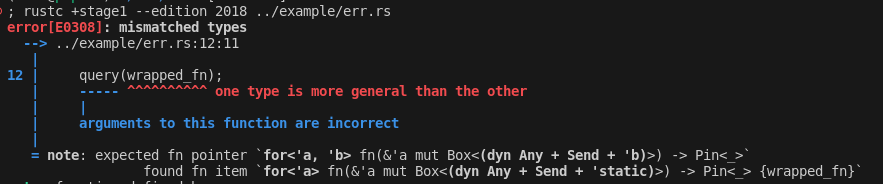
this diff from the test suite is also quite nice imo:
```diff
`@@` -4,8 +4,8 `@@` error[E0308]: mismatched types
LL | debug_assert_eq!(iter.next(), Some(value));
| ^^^^^^^^^^^ expected `Option<<I as Iterator>::Item>`, found `Option<&<I as Iterator>::Item>`
|
- = note: expected enum `Option<<I as Iterator>::Item>`
- found enum `Option<&<I as Iterator>::Item>`
+ = note: expected enum `Option<_>`
+ found enum `Option<&_>`
```
|
|
|
|
|
|
|
|
r=compiler-errors
Provide context when `?` can't be called because of `Result<_, E>`
When a method chain ending in `?` causes an E0277 because the expression's `Result::Err` variant doesn't have a type that can be converted to the `Result<_, E>` type parameter in the return type, provide additional context of which parts of the chain can and can't support the `?` operator.
```
error[E0277]: `?` couldn't convert the error to `String`
--> $DIR/question-mark-result-err-mismatch.rs:27:25
|
LL | fn bar() -> Result<(), String> {
| ------------------ expected `String` because of this
LL | let x = foo();
| ----- this has type `Result<_, String>`
...
LL | .map_err(|_| ())?;
| ---------------^ the trait `From<()>` is not implemented for `String`
| |
| this can't be annotated with `?` because it has type `Result<_, ()>`
|
= note: the question mark operation (`?`) implicitly performs a conversion on the error value using the `From` trait
= help: the following other types implement trait `From<T>`:
<String as From<char>>
<String as From<Box<str>>>
<String as From<Cow<'a, str>>>
<String as From<&str>>
<String as From<&mut str>>
<String as From<&String>>
= note: required for `Result<(), String>` to implement `FromResidual<Result<Infallible, ()>>`
```
Fix #72124.
|
|
|
|
Fix #72124.
|
|
|
|
When a method chain ending in `?` causes an E0277 because the
expression's `Result::Err` variant doesn't have a type that can be
converted to the `Result<_, E>` type parameter in the return type,
provide additional context of which parts of the chain can and can't
support the `?` operator.
```
error[E0277]: `?` couldn't convert the error to `String`
--> $DIR/question-mark-result-err-mismatch.rs:28:25
|
LL | fn bar() -> Result<(), String> {
| ------------------ expected `String` because of this
LL | let x = foo();
| ----- this can be annotated with `?` because it has type `Result<String, String>`
LL | let one = x
LL | .map(|s| ())
| ----------- this can be annotated with `?` because it has type `Result<(), String>`
LL | .map_err(|_| ())?;
| ---------------^ the trait `From<()>` is not implemented for `String`
| |
| this can't be annotated with `?` because it has type `Result<(), ()>`
|
= note: the question mark operation (`?`) implicitly performs a conversion on the error value using the `From` trait
= help: the following other types implement trait `From<T>`:
<String as From<char>>
<String as From<Box<str>>>
<String as From<Cow<'a, str>>>
<String as From<&str>>
<String as From<&mut str>>
<String as From<&String>>
= note: required for `Result<(), String>` to implement `FromResidual<Result<Infallible, ()>>`
```
Fix #72124.
|
|
|
|
|
|
|
|
|
|
|
|
Co-authored-by: Adrian <adrian.iosdev@gmail.com>
|
|
|
|
Aka trait_upcasting feature.
And also adjust the `deref_into_dyn_supertrait` lint.
|
|
intercrate_ambiguity_causes: handle self ty infer + reservation impls
r? `@compiler-errors`
|
|
Don't consider regions in `deref_into_dyn_supertrait` lint
I actually wonder if we should just warn on *any* deref impl with a target type that matches a supertrait by *def-id*.
cc #89460
r? types
|
|
r=compiler-errors
Note about object lifetime defaults in does not live long enough error
This is a aspect of Rust that frequently trips up people who are not aware of it yet. This diagnostic attempts to explain what's happening and why the lifetime constraint, that was never mentioned in the source, arose.
The implementation feels a bit questionable, I'm not sure whether there are better ways to do this. There probably are.
fixes #117835
r? types
|
|
|
|
|
|
|
|
|
|
|
|
new solver normalization improvements
cool beans
At the core of this PR is a `try_normalize_ty` which stops for rigid aliases by using `commit_if_ok`.
Reworks alias-relate to fully normalize both the lhs and rhs and then equate the resulting rigid (or inference) types. This fixes https://github.com/rust-lang/trait-system-refactor-initiative/issues/68 by avoiding the exponential blowup. Also supersedes #116369 by only defining opaque types if the hidden type is rigid.
I removed the stability check in `EvalCtxt::evaluate_goal` due to https://github.com/rust-lang/trait-system-refactor-initiative/issues/75. While I personally have opinions on how to fix it, that still requires further t-types/`@nikomatsakis` buy-in, so I removed that for now. Once we've decided on our approach there, we can revert this commit.
r? `@compiler-errors`
|
|
This is a aspect of Rust that frequently trips up people who are not
aware of it yet. This diagnostic attempts to explain what's happening
and why the lifetime constraint, that was never mentioned in the source,
arose.
|
|
|
|
|
|
|
|
|
|
assembly
|
