| Age | Commit message (Collapse) | Author | Lines |
|---|
|
starting from the x86_64-unknown-linux-gnu specs, we add the lld linker
flavor and self-contained linker component
|
|
const-eval: make misalignment a hard error
It's been a future-incompat error (showing up in cargo's reports) since https://github.com/rust-lang/rust/pull/104616, Rust 1.68, released in March. That should be long enough.
The question for the lang team is simply -- should we move ahead with this, making const-eval alignment failures a hard error? (It turns out some of them accidentally already were hard errors since #104616. But not all so this is still a breaking change. Crater found no regression.)
|
|
Detect ruby-style closure in parser
When parsing a closure without a body that is surrounded by a block, suggest moving the opening brace after the closure head.
Fix #116608.
|
|
Hide host effect params from docs
addresses (only on nightly, needs backport) https://github.com/rust-lang/rust/issues/116629
r? `@compiler-errors`
cc `@GuillaumeGomez` `@fee1-dead`
|
|
On type error involving closure, avoid ICE
When we encounter a type error involving a closure, we try to typeck prior closure invocations to see if they influenced the current expected type. When trying to do so, ensure that the closure was defined in our current scope.
Fix #116658.
|
|
Improve check-cfg diagnostics
This PR tries to improve some of the diagnostics of check-cfg.
The main changes is the unexpected name or value being added to the main diagnostic:
```diff
- warning: unexpected `cfg` condition name
+ warning: unexpected `cfg` condition name: `widnows`
```
It also cherry-pick the better sensible logic for when we print the list of expected values when we have a matching value for a very similar name.
Address https://github.com/rust-lang/rust/pull/111072#discussion_r1356818100
r? `@petrochenkov`
|
|
When we encounter a type error involving a closure, we try to typeck
prior closure invocations to see if they influenced the current expected
type. When trying to do so, ensure that the closure was defined in our
current scope.
Fix #116658.
|
|
When parsing a closure without a body that is surrounded by a block,
suggest moving the opening brace after the closure head.
Fix #116608.
|
|
exhaustiveness: Rework constructor splitting
`SplitWildcard` was pretty opaque. I replaced it with a more legible abstraction: `ConstructorSet` represents the set of constructors for patterns of a given type. This clarifies responsibilities: `ConstructorSet` handles one clear task, and diagnostic-related shenanigans can be done separately.
I'm quite excited, I had has this in mind for years but could never quite introduce it. This opens up possibilities, including type-specific optimisations (like using a `FxHashSet` to collect enum variants, which had been [hackily attempted some years ago](https://github.com/rust-lang/rust/pull/76918)), my one-pass rewrite (https://github.com/rust-lang/rust/pull/116042), and future librarification.
|
|
Copy 1-element arrays as scalars, not vectors
For `[T; 1]` it's silly to copy as `<1 x T>` when we can just copy as `T`.
Inspired by https://github.com/rust-lang/rust/issues/101210#issuecomment-1732470941, which pointed out that `Option<[u8; 1]>` was codegenning worse than `Option<u8>`.
(I'm not sure *why* LLVM doesn't optimize out `<1 x u8>`, but might as well just not emit it in the first place in this codepath.)
---
I think I bit off too much in #116479; let me try just the scalar case first.
r? `@ghost`
|
|
|
|
|
|
|
|
|
|
|
|
|
|
|
|
|
|
r=compiler-errors
Handle several `#[diagnostic::on_unimplemented]` attributes correctly
This PR fixes an issues where rustc would ignore subsequent `#[diagnostic::on_unimplemented]` attributes. The [corresponding RFC](https://rust-lang.github.io/rfcs/3368-diagnostic-attribute-namespace.html) specifies that the first matching instance of each option is used. Invalid attributes are linted and otherwise ignored.
|
|
|
|
|
|
Token cleanups
Some precursors to #114571 that are worth merging even if the main part of #114571 doesn't get merged.
r? `@petrochenkov`
|
|
Show enum discriminant if a compatible repr is used
Follow-up of #116142.
It was mentioned in the [team meeting](https://rust-lang.zulipchat.com/#narrow/stream/393423-t-rustdoc.2Fmeetings/topic/meeting.2002-10-2023/near/394504024) that an enum with a `repr` should also get its discriminants displayed. Forgot to implement it in #116142...
It also allowed to uncover a bug: i was not providing the correct `DefId` in case it was a type alias to `render_enum_fields`. It's also fixed in this PR.
r? `@fmease`
|
|
Use structured suggestion for #113174
When encountering a for loop that is rejected by the borrow checker because it is being advanced within its body, provide a structured suggestion for `while let Some(pat) = iter.next()`.
|
|
Explaining something in the output that surprised me.
|
|
|
|
This PR fixes an issues where rustc would ignore subsequent
`#[diagnostic::on_unimplemented]` attributes. The [corresponding
RFC](https://rust-lang.github.io/rfcs/3368-diagnostic-attribute-namespace.html)
specifies that the first matching instance of each option is used.
Invalid attributes are linted and otherwise ignored.
|
|
When encountering a for loop that is rejected by the borrow checker
because it is being advanced within its body, provide a structured
suggestion for `while let Some(pat) = iter.next()`.
|
|
Prevent showing methods from blanket impls of not available foreign traits to show up in the search results
Fixes https://github.com/rust-lang/rust/issues/115480.
In the case that the blanket impl trait is not available in the current crate, we prevent adding its methods in the search index.
Now how I found how to fix the issue: the `equivalent` method is not generated in the documentation pages but was still added to the search index. To render impls, we iterate over `cache.impls` so I took a look at how this was generated. Inside `formats/cache.rs`, we have `CacheBuilder::populate` where we push impls into `impls` but with this condition:
```rust
if cx.cache.traits.contains_key(&trait_did) {
```
I re-used this condition in `CacheBuilder::fold_item` to prevent this method from being added in `cache.search_index` or `cache.orphan_impl_items`.
PS: If you want to double-check if the added test works, just comment the code I added in `cache.rs` and it should fail.
r? ``@notriddle``
|
|
compiler-errors:structurally-normalize-for-closure, r=lcnr
Structurally normalize for closure
Fixes some signature deduction problems in the new trait solver (and in the case of async, an ICE).
r? lcnr
|
|
Relate alias ty with variance
In the new solver, turns out that the subst-relate branch of the alias-relate predicate was relating args invariantly even for opaques, which have variance :skull:.
This change is a bit more invasive, but I'd rather not special-case it [here](https://github.com/rust-lang/rust/blob/aeaa5c30e5c9041264a2e8314b68ad84c2dc3169/compiler/rustc_trait_selection/src/solve/alias_relate.rs#L171-L190) and then have it break elsewhere. I'm doing a perf run to see if the extra call to `def_kind` is that expensive, if it is, I'll reconsider.
r? ``@lcnr``
|
|
Prevent spurious `unreachable pattern` lints
But it means we'll get more `non-exhaustive` patterns
fixes https://github.com/rust-lang/rust/issues/78057
r? `@Nadrieril` `@RalfJung`
|
|
|
|
Means you'll get more `non-exhaustive` patterns
|
|
Implement `-Clink-self-contained=-linker` opt out
This implements the `-Clink-self-contained` opt out necessary to switch to lld by changing rustc's defaults instead of cargo's.
Components that are enabled and disabled on the CLI are recorded, for the purpose of being merged with the ones which the target spec will declare (I'll open another PR for that tomorrow, for easier review).
For MCP510, we now check whether using the self-contained linker is disabled on the CLI. Right now it would only be sensible to with `-Zgcc-ld=lld` (and I'll add some checks that we don't both enable and disable a component on the CLI in a future PR), but the goal is to simplify adding the check of the target's enabled components here in the follow-up PRs.
r? `@petrochenkov`
|
|
Fix overflow checking in range patterns
When a range pattern contains an overflowing literal, if we're not careful we might not notice the overflow and use the wrapped value. This makes for confusing error messages because linting against overflowing literals is only done in a later pass. So when a range is invalid we check for overflows to provide a better error.
This check didn't use to handle negative types; this PR fixes that. First commit adds tests, second cleans up without changing behavior, third does the fix.
EDIT: while I was at it, I fixed a small annoyance about the span of the overflow lint on negated literals.
Fixes https://github.com/rust-lang/rust/issues/94239
|
|
|
|
rustdoc: show crate name beside smaller logo
*Blocked on https://github.com/rust-lang/cargo/pull/12800*
## Summary
In this PR, the crate name and version are always shown in the sidebar, even in subpages, and the lateral navigation is always shown in the sidebar, even in modules.
Clicking the crate name does the same thing clicking the logo always did: take you to the crate root (the crate's home page, at least within Rustdoc).
The Rust logo is also no longer shown by default for non-Rust docs.
### Screenshots
<details><summary>Before</summary>
| | Macro | Module |
|--|-------|--------|
| In crate | 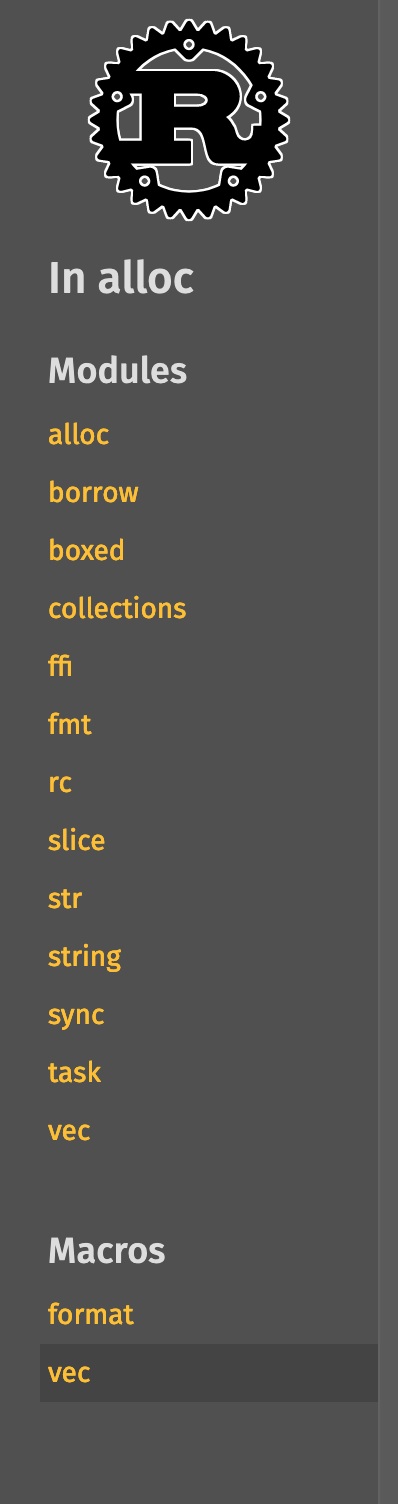 |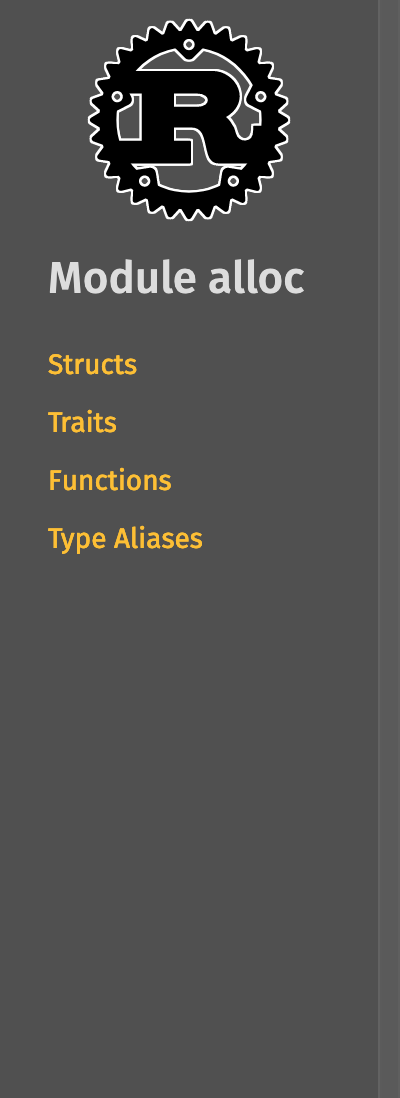
| In module[^1] |  | 
[^1]: This PR also includes a bug fix for derive macros not showing up in the lateral navigation part of the sidebar
</details>
#### Whole sidebar screenshots
| | Macro | Module |
|--|-------|--------|
| In crate | 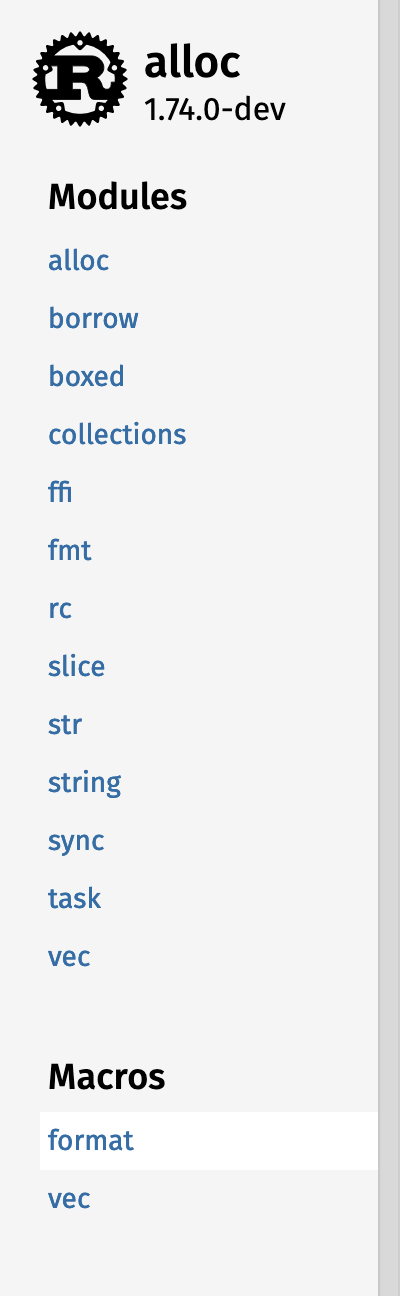 | 
| In module | 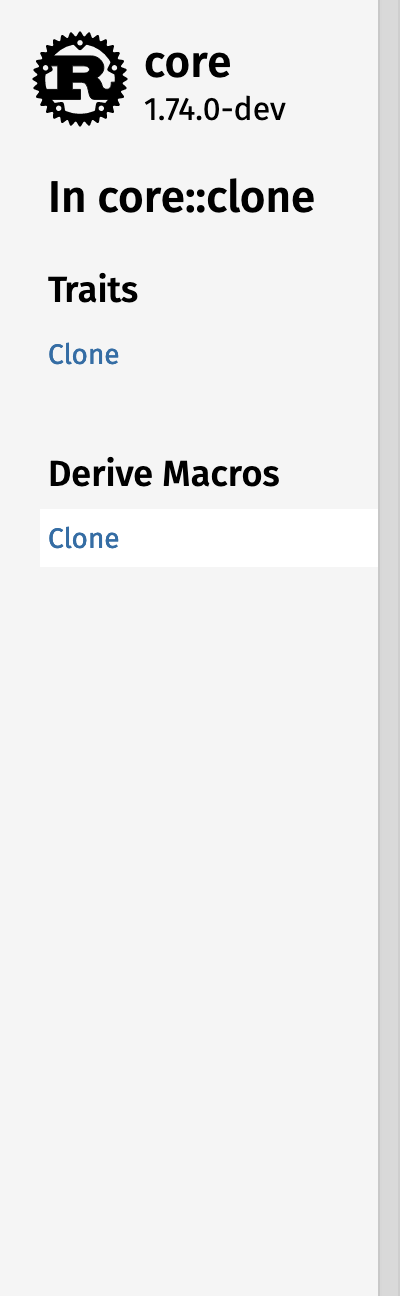 | 
#### Different logo configurations
| | Short crate name | Long crate name |
|---------|------------------|-----------------|
| Root | ![short-root] | ![long-root]
| Subpage | ![short-subpage] | ![long-subpage]
[short-root]: https://github.com/rust-lang/rust/assets/1593513/9e2b4fa8-f581-4106-b562-1e0372c13f79
[short-subpage]: https://github.com/rust-lang/rust/assets/1593513/8331cdb8-fa13-4671-a1e2-dcc1cdca7451
[long-root]: https://github.com/rust-lang/rust/assets/1593513/7d377fec-0f1d-4343-9f82-0e35a8f58056
[long-subpage]: https://github.com/rust-lang/rust/assets/1593513/3b3094a4-63c9-477c-8c15-b6075837df30
##### Without a logo

### Preview pages
https://notriddle.com/rustdoc-html-demo-5/sidebar-layout-rocket/rocket/index.html
https://notriddle.com/rustdoc-html-demo-5/sidebar-layout-rocket/rocket_sync_db_pools/index.html
https://notriddle.com/rustdoc-html-demo-5/sidebar-layout-rust-compiler/index.html
https://notriddle.com/rustdoc-html-demo-5/sidebar-layout-rust/std/index.html
https://notriddle.com/rustdoc-html-demo-5/sidebar-layout-rocket/tokio/index.html
## Motivation
This improves visual information density (the construct with the logo and crate name is *shorter* than the logo on its own, because it's not square) and navigation clarity (we can now see what clicking the Rust logo does, specifically).
Compare this with the layout at [Phoenix's Hexdocs] (which is what this proposal is closely based on), the old proposal on [Internals Discourse] (which always says "Rust standard library" in the sidebar, but doesn't do the side-by-side layout).
[Phoenix's Hexdocs]: https://hexdocs.pm/phoenix/1.7.7/overview.html
[Internals Discourse]: https://internals.rust-lang.org/t/poc-of-a-new-design-for-the-generated-rustdoc/11018
## Guide-level explanation
This PR cleans up some of the sidebar navigation.
It makes the logo in the desktop sidebar a bit smaller, and puts the crate name and version next to it (either beside it, or below it, depending on if there's space), making it clearer what clicking on it does: click the crate name to open the crate's home page. It also removes the Rust logo from non-official-Rust crates, again to make the navigation and supply chain clearer (since the crate name has been added, the logo is no longer necessary for navigation).
It adds a bit more clarifying information for lateral navigation. On items that don't add their own sidebar items, it just shows its siblings directly below the crate name and logo, but for other items, it shows "In crate alloc" instead of just "In alloc". It also shows the lateral navigation tools on module pages, making modules consistent with every other item.
## Drawbacks
While this actually takes up less screen real estate than the old layout on desktop, it takes up more HTML. It's also a bit more visually complex.
## Rationale and alternatives
I could do what the Internals POC did and keep the vertically stacked layout all the time, instead of doing a horizontal stack where possible. It would take up more screen real estate, though.
## Prior art
This design is lifted almost verbatim from Hexdocs. It seems to work for them. [`opentelemetry_process_propagator`], for example, has a long application name.
[`opentelemetry_process_propagator`]: https://hexdocs.pm/opentelemetry_process_propagator/OpentelemetryProcessPropagator.html
## Unresolved questions
Maybe we should encourage crate authors to include their own logo more often? It certainly helps give people a better sense of "place." This seems to be blocked on coming up with an API to do it without requiring them to host the file somewhere.
## Future possibilities
Beyond this, plenty of other changes could be made to improve the layout, like
* Fix things so that clicking an item in the sidebar doesn't cause it to scroll back to the top.
* The [Internals demo](https://utherii.github.io/new.html) does this right: clicking an item in the sidebar changes the content area, but the sidebar itself does not change. This is nice, because clicking is cheap and I can skim the opening few paragraphs while browsing.
* The layout of the docs sidebar causes trouble to implement this, because it's different on different pages, but at least fix this on the file browser.
* Come up with a less cluttered way to do disclosure. There's a lot of `[-]` on the page.
* We don't lack ideas to fix this one. We have *too many*.
* Do a better job of separating local navigation (vec::Vec links to vec::IntoIter) and the table of contents (vec::Vec links to vec::Vec::new).
* A possibility: add a Back arrow next to the "In [module]" header?
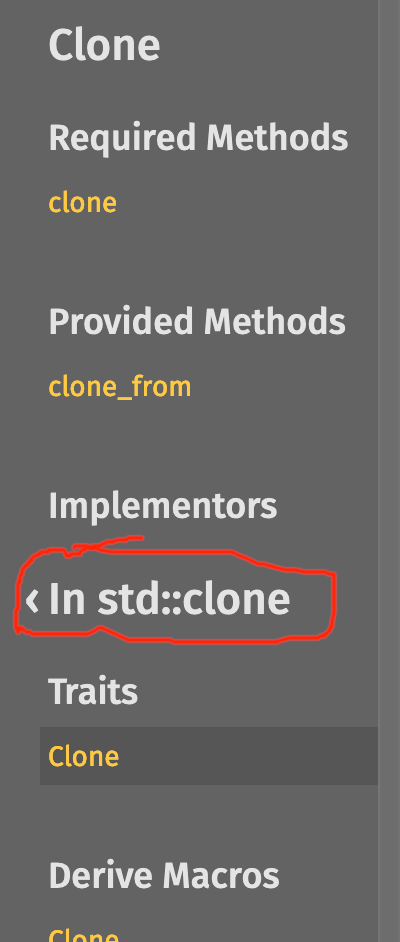
* Give readers more control of how much rustdoc shows them, and giving doc authors more control of how much it generates. Basically, https://github.com/rust-lang/rust/pull/115660 is great, let's do it too.
But those are mostly orthogonal, not future possibilities unlocked by this change.
|
|
|
|
|
|
|
|
delay a bug when encountering an ambiguity in MIR typeck
We shouldn't have any trait selection ambiguities in MIR typeck.
See https://github.com/rust-lang/rust/pull/114586#issuecomment-1751967321
r? `@oli-obk` `@compiler-errors` `@lcnr`
|
|
Also consider call and yield as MIR SSA.
The SSA analysis on MIR only considered `Assign` statements as defining a SSA local.
This PR adds assignments as part of a `Call` or `Yield` terminator in that category.
This mainly allows to perform CopyProp on a call return place.
The only subtlety is in the dominance property: the assignment is only complete at the beginning of the target block.
|
|
add test for const-eval error in dead code during monomorphization
|
|
On type error of closure call argument, point at earlier calls that affected inference
Mitigate part of https://github.com/rust-lang/rust/issues/71209.
When we encounter a type error on a specific argument of a closure call argument, where the closure's definition doesn't have a type specified, look for other calls of the closure to try and find the specific call that cased that argument to be inferred of the expected type.
```
error[E0308]: mismatched types
--> $DIR/unboxed-closures-type-mismatch.rs:30:18
|
LL | identity(1u16);
| -------- ^^^^ expected `u8`, found `u16`
| |
| arguments to this function are incorrect
|
note: expected because the closure was earlier called with an argument of type `u8`
--> $DIR/unboxed-closures-type-mismatch.rs:29:18
|
LL | identity(1u8);
| -------- ^^^ expected because this argument is of type `u8`
| |
| in this closure call
note: closure parameter defined here
--> $DIR/unboxed-closures-type-mismatch.rs:28:25
|
LL | let identity = |x| x;
| ^
help: change the type of the numeric literal from `u16` to `u8`
|
LL | identity(1u8);
| ~~
```
|
|
r=GuillaumeGomez
rustdoc-search: add impl disambiguator to duplicate assoc items
Preview (to see the difference, click the link and pay attention to the specific function that comes up):
| Before | After |
|--|--|
| [`simd<i64>, simd<i64> -> simd<i64>`](https://doc.rust-lang.org/nightly/std/?search=simd%3Ci64%3E%2C%20simd%3Ci64%3E%20-%3E%20simd%3Ci64%3E) | [`simd<i64>, simd<i64> -> simd<i64>`](https://notriddle.com/rustdoc-demo-html-3/impl-disambiguate-search/std/index.html?search=simd%3Ci64%3E%2C%20simd%3Ci64%3E%20-%3E%20simd%3Ci64%3E) |
| [`cow, vec -> bool`](https://doc.rust-lang.org/nightly/std/?search=cow%2C%20vec%20-%3E%20bool) | [`cow, vec -> bool`](https://notriddle.com/rustdoc-demo-html-3/impl-disambiguate-search/std/index.html?search=cow%2C%20vec%20-%3E%20bool)
Helps with #90929
This changes the search results, specifically, when there's more than one impl with an associated item with the same name. For example, the search queries `simd<i8> -> simd<i8>` and `simd<i64> -> simd<i64>` don't link to the same function, but most of the functions have the same names.
This change should probably be FCP-ed, especially since it adds a new anchor link format for `main.js` to handle, so that URLs like `struct.Vec.html#impl-AsMut<[T]>-for-Vec<T,+A>/method.as_mut` redirect to `struct.Vec.html#method.as_mut-2`. It's a strange design, but there are a few reasons for it:
* I'd like to avoid making the HTML bigger. Obviously, fixing this bug is going to add at least a little more data to the search index, but adding more HTML penalises viewers for the benefit of searchers.
* Breaking `struct.Vec.html#method.len` would also be a disappointment.
On the other hand:
* The path-style anchors might be less prone to link rot than the numbered anchors. It's definitely less likely to have URLs that appear to "work", but silently point at the wrong thing.
* This commit arranges the path-style anchor to redirect to the numbered anchor. Nothing stops rustdoc from doing the opposite, making path-style anchors the default and redirecting the "legacy" numbered ones.
### The bug
On the "Before" links, this example search calls for `i64`:

But if I click any of the results, I get `f64` instead.

The PR fixes this problem by adding enough information to the search result `href` to disambiguate methods with different types but the same name.
More detailed description of the problem at:
https://github.com/rust-lang/rust/pull/109422#issuecomment-1491089293
> When a struct/enum/union has multiple impls with different type parameters, it can have multiple methods that have the same name, but which are on different impls. Besides Simd, [Any](https://doc.rust-lang.org/nightly/std/any/trait.Any.html?search=any%3A%3Adowncast) also demonstrates this pattern. It has three methods named `downcast`, on three different impls.
>
> When that happens, it presents a challenge in linking to the method. Normally we link like `#method.foo`. When there are multiple `foo`, we number them like `#method.foo`, `#method.foo-1`, `#method.foo-2`, etc.
>
> It also presents a challenge for our search code. Currently we store all the variants in the index, but don’t have any way to generate unambiguous URLs in the results page, or to distinguish them in the SERP.
>
> To fix this, we need three things:
>
> 1. A fragment format that fully specifies the impl type parameters when needed to disambiguate (`#impl-SimdOrd-for-Simd<i64,+LANES>/method.simd_max`)
> 2. A search index that stores methods with enough information to disambiguate the impl they were on.
> 3. A search results interface that can display multiple methods on the same type with the same name, when appropriate OR a disambiguation landing section on item pages?
>
> For reviewers: it can be hard to see the new fragment format in action since it immediately gets rewritten to the numbered form.
|
|
Improve handling of assertion failures with very long conditions
It's not perfectly clear what the best behaviour is here, but I think this is an improvement.
r? `@matthewjasper`
cc `@m-ou-se`
|
|
Suggest labeling block if `break` is in bare block
Fix #103982.
|
|
|
|
The assertion in `assert-long-condition.rs` used to be fail like this, all on
one line:
```
thread 'main' panicked at 'assertion failed: 1 + 2 + 3 + 4 + 5 + 6 + 7 + 8 + 9 + 10 + 11 + 12 + 13 + 14 + 15 + 16 + 17 + 18\n + 19 + 20 + 21 + 22 + 23 + 24 + 25 == 0', tests/ui/macros/assert-long-condition.rs:7:5
```
The `\n` and subsequent indent is because the condition is pretty-printed, and
the pretty-printer inserts a newline. Printing the newline in this way is
arguably reasonable given that the message appears within single quotes, which
is very similar to a string literal.
However, after the assertion printing improvements that were released in 1.73,
the assertion now fails like this:
```
thread 'main' panicked at tests/ui/macros/assert-long-condition.rs:7:5:
assertion failed: 1 + 2 + 3 + 4 + 5 + 6 + 7 + 8 + 9 + 10 + 11 + 12 + 13 + 14 + 15 + 16 + 17 + 18\n + 19 + 20 + 21 + 22 + 23 + 24 + 25 == 0
```
Now that there are no single quotes around the pretty-printed condition, the
`\n` is quite strange.
This commit gets rid of the `\n`, by removing the `escape_debug` done on the
pretty-printed message. This results in the following:
```
thread 'main' panicked at tests/ui/macros/assert-long-condition.rs:7:5:
assertion failed: 1 + 2 + 3 + 4 + 5 + 6 + 7 + 8 + 9 + 10 + 11 + 12 + 13 + 14 + 15 + 16 + 17 + 18
+ 19 + 20 + 21 + 22 + 23 + 24 + 25 == 0
```
The overly-large indent is still strange, but that's a separate pretty-printing issue.
This change helps with #108341.
|
