
diff options
| author | Matthias Krüger <matthias.krueger@famsik.de> | 2024-03-05 06:40:29 +0100 |
|---|---|---|
| committer | GitHub <noreply@github.com> | 2024-03-05 06:40:29 +0100 |
| commit | 22827fd5b1ca5f4a588dab2ae50c3b7a138d89b0 (patch) | |
| tree | 554fe466f63f6a535700f907bcbf3024931eb612 /library/alloc/src/vec | |
| parent | c2f6c0b8062c3903e1ade11179f5a0c4256d2e00 (diff) | |
| parent | 74151cbbf04477b646c7fcfd1db60f9c79c06081 (diff) | |
Rollup merge of #121262 - 20jasper:add-vector-time-complexity, r=cuviper
Add vector time complexity Added time complexity for `Vec` methods `push`, `push_within_capacity`, `pop`, and `insert`. <details> <summary> Reference images </summary> 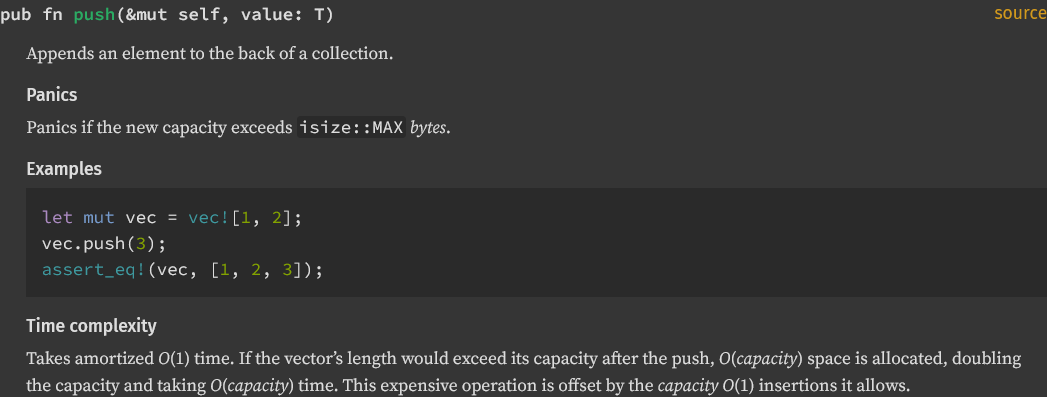 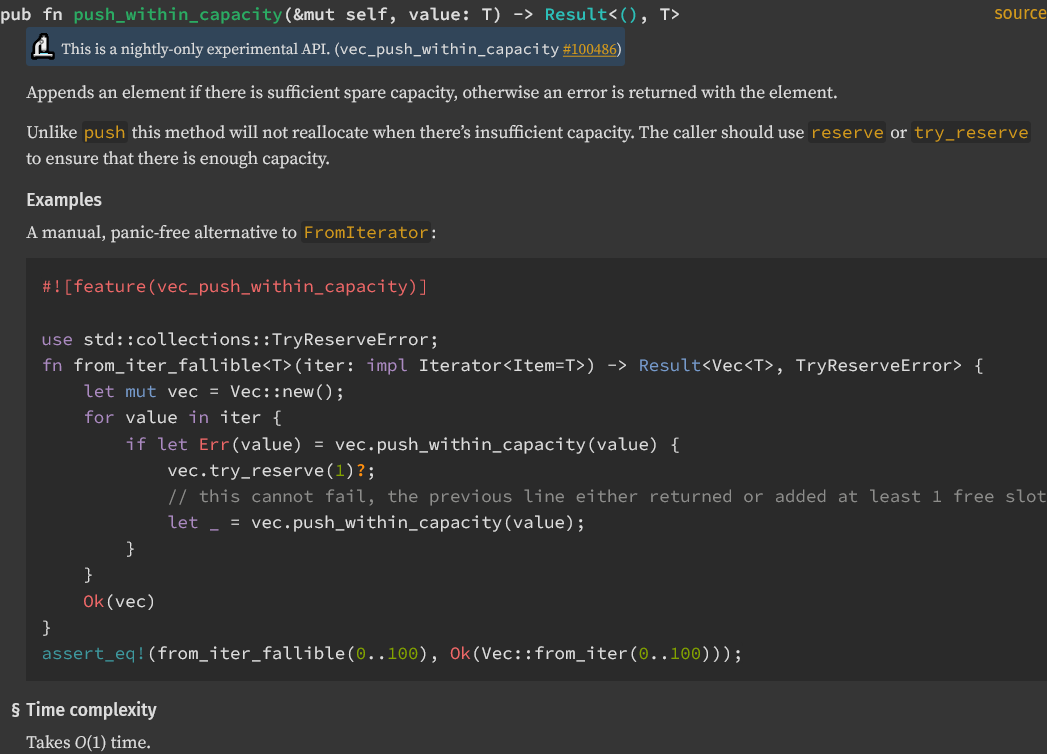 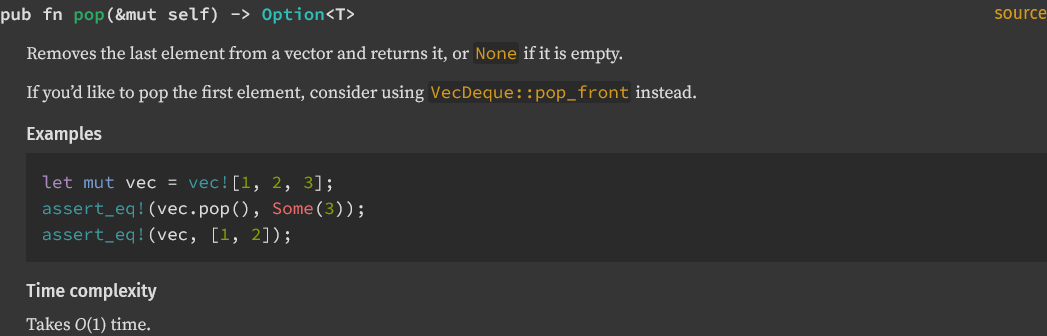 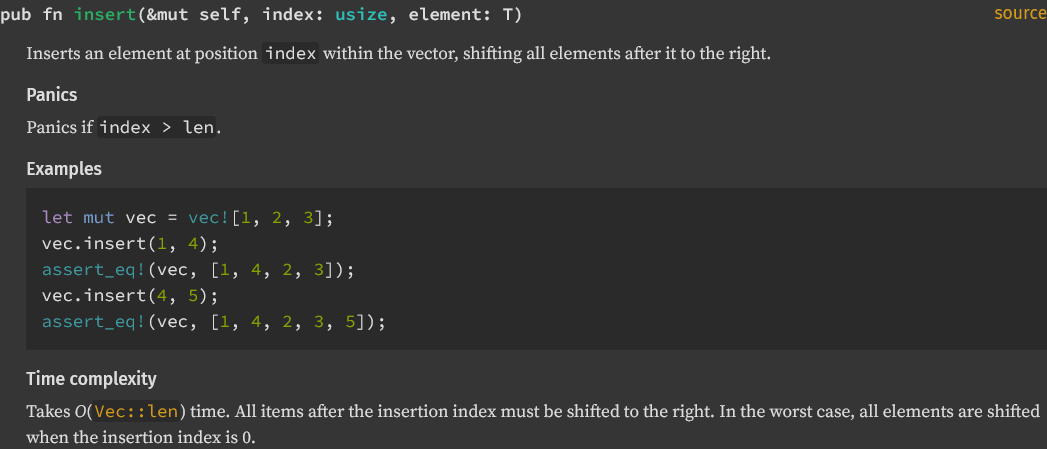 </details> I followed a convention to use `#Time complexity` that I found in [the `BinaryHeap` documentation](https://doc.rust-lang.org/std/collections/struct.BinaryHeap.html#time-complexity-1). Looking through the rest of standard library collections, there is not a consistent way to handle this. [`Vec::swap_remove`](https://doc.rust-lang.org/std/vec/struct.Vec.html#method.swap_remove) does not have a dedicated section for time complexity but does list it. [`VecDeque::rotate_left`](https://doc.rust-lang.org/std/collections/struct.VecDeque.html#complexity) uses a `#complexity` heading.
Diffstat (limited to 'library/alloc/src/vec')
| -rw-r--r-- | library/alloc/src/vec/mod.rs | 21 |
1 files changed, 21 insertions, 0 deletions
diff --git a/library/alloc/src/vec/mod.rs b/library/alloc/src/vec/mod.rs index 7bd19875584..c0e934b3b1f 100644 --- a/library/alloc/src/vec/mod.rs +++ b/library/alloc/src/vec/mod.rs @@ -1490,6 +1490,12 @@ impl<T, A: Allocator> Vec<T, A> { /// vec.insert(4, 5); /// assert_eq!(vec, [1, 4, 2, 3, 5]); /// ``` + /// + /// # Time complexity + /// + /// Takes *O*([`Vec::len`]) time. All items after the insertion index must be + /// shifted to the right. In the worst case, all elements are shifted when + /// the insertion index is 0. #[cfg(not(no_global_oom_handling))] #[stable(feature = "rust1", since = "1.0.0")] pub fn insert(&mut self, index: usize, element: T) { @@ -1913,6 +1919,13 @@ impl<T, A: Allocator> Vec<T, A> { /// vec.push(3); /// assert_eq!(vec, [1, 2, 3]); /// ``` + /// + /// # Time complexity + /// + /// Takes amortized *O*(1) time. If the vector's length would exceed its + /// capacity after the push, *O*(*capacity*) time is taken to copy the + /// vector's elements to a larger allocation. This expensive operation is + /// offset by the *capacity* *O*(1) insertions it allows. #[cfg(not(no_global_oom_handling))] #[inline] #[stable(feature = "rust1", since = "1.0.0")] @@ -1961,6 +1974,10 @@ impl<T, A: Allocator> Vec<T, A> { /// } /// assert_eq!(from_iter_fallible(0..100), Ok(Vec::from_iter(0..100))); /// ``` + /// + /// # Time complexity + /// + /// Takes *O*(1) time. #[inline] #[unstable(feature = "vec_push_within_capacity", issue = "100486")] pub fn push_within_capacity(&mut self, value: T) -> Result<(), T> { @@ -1990,6 +2007,10 @@ impl<T, A: Allocator> Vec<T, A> { /// assert_eq!(vec.pop(), Some(3)); /// assert_eq!(vec, [1, 2]); /// ``` + /// + /// # Time complexity + /// + /// Takes *O*(1) time. #[inline] #[stable(feature = "rust1", since = "1.0.0")] pub fn pop(&mut self) -> Option<T> { |