
diff options
| author | bors <bors@rust-lang.org> | 2022-03-04 00:27:23 +0000 |
|---|---|---|
| committer | bors <bors@rust-lang.org> | 2022-03-04 00:27:23 +0000 |
| commit | 6d7684101a51f1c375ec84aef5d2fbdeb214bbc2 (patch) | |
| tree | d86722eb5dda8ae7ef9980dd4a19deebb9f37cf4 /src/librustdoc/clean | |
| parent | 40d3040ae19b8c43c0027bc6d3e9805e5ee5e0ee (diff) | |
| parent | 0e57a16c88cbb042bf4d19934e0ccdd3838645ec (diff) | |
| download | rust-6d7684101a51f1c375ec84aef5d2fbdeb214bbc2.tar.gz rust-6d7684101a51f1c375ec84aef5d2fbdeb214bbc2.zip | |
Auto merge of #94009 - compiler-errors:gat-rustdoc, r=GuillaumeGomez
Support GATs in Rustdoc Implements: 1. Rendering GATs in trait definitions and impl blocks 2. Rendering GATs in types (e.g. in the return type of a function) Fixes #92341 This is my first rustdoc PR, so I have absolutely no idea how to produce tests for this. Advice from the rustdoc team would be wonderful! I tested locally and things looked correct: 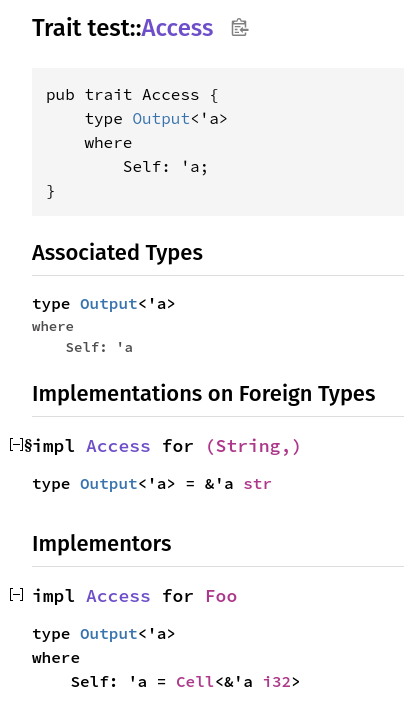
Diffstat (limited to 'src/librustdoc/clean')
| -rw-r--r-- | src/librustdoc/clean/auto_trait.rs | 6 | ||||
| -rw-r--r-- | src/librustdoc/clean/inline.rs | 2 | ||||
| -rw-r--r-- | src/librustdoc/clean/mod.rs | 161 | ||||
| -rw-r--r-- | src/librustdoc/clean/simplify.rs | 4 | ||||
| -rw-r--r-- | src/librustdoc/clean/types.rs | 20 |
5 files changed, 133 insertions, 60 deletions
diff --git a/src/librustdoc/clean/auto_trait.rs b/src/librustdoc/clean/auto_trait.rs index a3154d8f03b..62f3527525e 100644 --- a/src/librustdoc/clean/auto_trait.rs +++ b/src/librustdoc/clean/auto_trait.rs @@ -546,11 +546,11 @@ impl<'a, 'tcx> AutoTraitFinder<'a, 'tcx> { } WherePredicate::EqPredicate { lhs, rhs } => { match lhs { - Type::QPath { name: left_name, ref self_type, ref trait_, .. } => { + Type::QPath { ref assoc, ref self_type, ref trait_, .. } => { let ty = &*self_type; let mut new_trait = trait_.clone(); - if self.is_fn_trait(trait_) && left_name == sym::Output { + if self.is_fn_trait(trait_) && assoc.name == sym::Output { ty_to_fn .entry(*ty.clone()) .and_modify(|e| { @@ -571,7 +571,7 @@ impl<'a, 'tcx> AutoTraitFinder<'a, 'tcx> { // to 'T: Iterator<Item=u8>' GenericArgs::AngleBracketed { ref mut bindings, .. } => { bindings.push(TypeBinding { - name: left_name, + assoc: *assoc.clone(), kind: TypeBindingKind::Equality { term: rhs }, }); } diff --git a/src/librustdoc/clean/inline.rs b/src/librustdoc/clean/inline.rs index 3ae1df51695..2e66db425d6 100644 --- a/src/librustdoc/clean/inline.rs +++ b/src/librustdoc/clean/inline.rs @@ -636,7 +636,7 @@ fn filter_non_trait_generics(trait_did: DefId, mut g: clean::Generics) -> clean: g.where_predicates.retain(|pred| match pred { clean::WherePredicate::BoundPredicate { - ty: clean::QPath { self_type: box clean::Generic(ref s), trait_, name: _, .. }, + ty: clean::QPath { self_type: box clean::Generic(ref s), trait_, .. }, bounds, .. } => !(bounds.is_empty() || *s == kw::SelfUpper && trait_.def_id() == trait_did), diff --git a/src/librustdoc/clean/mod.rs b/src/librustdoc/clean/mod.rs index 8fad625973f..0d1482ce470 100644 --- a/src/librustdoc/clean/mod.rs +++ b/src/librustdoc/clean/mod.rs @@ -388,7 +388,7 @@ impl<'tcx> Clean<Type> for ty::ProjectionTy<'tcx> { let trait_ = lifted.trait_ref(cx.tcx).clean(cx); let self_type = self.self_ty().clean(cx); Type::QPath { - name: cx.tcx.associated_item(self.item_def_id).name, + assoc: Box::new(projection_to_path_segment(*self, cx)), self_def_id: self_type.def_id(&cx.cache), self_type: box self_type, trait_, @@ -396,6 +396,27 @@ impl<'tcx> Clean<Type> for ty::ProjectionTy<'tcx> { } } +fn projection_to_path_segment(ty: ty::ProjectionTy<'_>, cx: &mut DocContext<'_>) -> PathSegment { + let item = cx.tcx.associated_item(ty.item_def_id); + let generics = cx.tcx.generics_of(ty.item_def_id); + PathSegment { + name: item.name, + args: GenericArgs::AngleBracketed { + args: ty.substs[generics.parent_count..] + .iter() + .map(|ty| match ty.unpack() { + ty::subst::GenericArgKind::Lifetime(lt) => { + GenericArg::Lifetime(lt.clean(cx).unwrap()) + } + ty::subst::GenericArgKind::Type(ty) => GenericArg::Type(ty.clean(cx)), + ty::subst::GenericArgKind::Const(c) => GenericArg::Const(Box::new(c.clean(cx))), + }) + .collect(), + bindings: Default::default(), + }, + } +} + impl Clean<GenericParamDef> for ty::GenericParamDef { fn clean(&self, cx: &mut DocContext<'_>) -> GenericParamDef { let (name, kind) = match self.kind { @@ -601,8 +622,8 @@ fn clean_ty_generics( }) .collect::<Vec<GenericParamDef>>(); - // param index -> [(DefId of trait, associated type name, type)] - let mut impl_trait_proj = FxHashMap::<u32, Vec<(DefId, Symbol, Ty<'_>)>>::default(); + // param index -> [(DefId of trait, associated type name and generics, type)] + let mut impl_trait_proj = FxHashMap::<u32, Vec<(DefId, PathSegment, Ty<'_>)>>::default(); let where_predicates = preds .predicates @@ -648,8 +669,9 @@ fn clean_ty_generics( let proj = projection .map(|p| (p.skip_binder().projection_ty.clean(cx), p.skip_binder().term)); - if let Some(((_, trait_did, name), rhs)) = - proj.as_ref().and_then(|(lhs, rhs)| Some((lhs.projection()?, rhs))) + if let Some(((_, trait_did, name), rhs)) = proj + .as_ref() + .and_then(|(lhs, rhs): &(Type, _)| Some((lhs.projection()?, rhs))) { // FIXME(...): Remove this unwrap() impl_trait_proj.entry(param_idx).or_default().push(( @@ -992,9 +1014,10 @@ impl Clean<Item> for hir::TraitItem<'_> { TyMethodItem(t) } hir::TraitItemKind::Type(bounds, ref default) => { + let generics = enter_impl_trait(cx, |cx| self.generics.clean(cx)); let bounds = bounds.iter().filter_map(|x| x.clean(cx)).collect(); let default = default.map(|t| t.clean(cx)); - AssocTypeItem(bounds, default) + AssocTypeItem(Box::new(generics), bounds, default) } }; let what_rustc_thinks = @@ -1026,15 +1049,9 @@ impl Clean<Item> for hir::ImplItem<'_> { } hir::ImplItemKind::TyAlias(ref hir_ty) => { let type_ = hir_ty.clean(cx); + let generics = self.generics.clean(cx); let item_type = hir_ty_to_ty(cx.tcx, hir_ty).clean(cx); - TypedefItem( - Typedef { - type_, - generics: Generics::default(), - item_type: Some(item_type), - }, - true, - ) + TypedefItem(Typedef { type_, generics, item_type: Some(item_type) }, true) } }; @@ -1140,35 +1157,79 @@ impl Clean<Item> for ty::AssocItem { ty::AssocKind::Type => { let my_name = self.name; + fn param_eq_arg(param: &GenericParamDef, arg: &GenericArg) -> bool { + match (¶m.kind, arg) { + (GenericParamDefKind::Type { .. }, GenericArg::Type(Type::Generic(ty))) + if *ty == param.name => + { + true + } + ( + GenericParamDefKind::Lifetime { .. }, + GenericArg::Lifetime(Lifetime(lt)), + ) if *lt == param.name => true, + (GenericParamDefKind::Const { .. }, GenericArg::Const(c)) => { + match &c.kind { + ConstantKind::TyConst { expr } => expr == param.name.as_str(), + _ => false, + } + } + _ => false, + } + } + if let ty::TraitContainer(_) = self.container { let bounds = tcx.explicit_item_bounds(self.def_id); let predicates = ty::GenericPredicates { parent: None, predicates: bounds }; - let generics = clean_ty_generics(cx, tcx.generics_of(self.def_id), predicates); + let mut generics = + clean_ty_generics(cx, tcx.generics_of(self.def_id), predicates); + // Filter out the bounds that are (likely?) directly attached to the associated type, + // as opposed to being located in the where clause. let mut bounds = generics .where_predicates - .iter() - .filter_map(|pred| { - let (name, self_type, trait_, bounds) = match *pred { - WherePredicate::BoundPredicate { - ty: QPath { ref name, ref self_type, ref trait_, .. }, - ref bounds, - .. - } => (name, self_type, trait_, bounds), - _ => return None, - }; - if *name != my_name { - return None; - } - if trait_.def_id() != self.container.id() { - return None; + .drain_filter(|pred| match *pred { + WherePredicate::BoundPredicate { + ty: QPath { ref assoc, ref self_type, ref trait_, .. }, + .. + } => { + if assoc.name != my_name { + return false; + } + if trait_.def_id() != self.container.id() { + return false; + } + match **self_type { + Generic(ref s) if *s == kw::SelfUpper => {} + _ => return false, + } + match &assoc.args { + GenericArgs::AngleBracketed { args, bindings } => { + if !bindings.is_empty() + || generics + .params + .iter() + .zip(args) + .any(|(param, arg)| !param_eq_arg(param, arg)) + { + return false; + } + } + GenericArgs::Parenthesized { .. } => { + // The only time this happens is if we're inside the rustdoc for Fn(), + // which only has one associated type, which is not a GAT, so whatever. + } + } + true } - match **self_type { - Generic(ref s) if *s == kw::SelfUpper => {} - _ => return None, + _ => false, + }) + .flat_map(|pred| { + if let WherePredicate::BoundPredicate { bounds, .. } = pred { + bounds + } else { + unreachable!() } - Some(bounds) }) - .flat_map(|i| i.iter().cloned()) .collect::<Vec<_>>(); // Our Sized/?Sized bound didn't get handled when creating the generics // because we didn't actually get our whole set of bounds until just now @@ -1188,7 +1249,7 @@ impl Clean<Item> for ty::AssocItem { None }; - AssocTypeItem(bounds, ty.map(|t| t.clean(cx))) + AssocTypeItem(Box::new(generics), bounds, ty.map(|t| t.clean(cx))) } else { // FIXME: when could this happen? Associated items in inherent impls? let type_ = tcx.type_of(self.def_id).clean(cx); @@ -1259,7 +1320,7 @@ fn clean_qpath(hir_ty: &hir::Ty<'_>, cx: &mut DocContext<'_>) -> Type { }; register_res(cx, trait_.res); Type::QPath { - name: p.segments.last().expect("segments were empty").ident.name, + assoc: Box::new(p.segments.last().expect("segments were empty").clean(cx)), self_def_id: Some(DefId::local(qself.hir_id.owner.local_def_index)), self_type: box qself.clean(cx), trait_, @@ -1276,7 +1337,7 @@ fn clean_qpath(hir_ty: &hir::Ty<'_>, cx: &mut DocContext<'_>) -> Type { let trait_ = hir::Path { span, res, segments: &[] }.clean(cx); register_res(cx, trait_.res); Type::QPath { - name: segment.ident.name, + assoc: Box::new(segment.clean(cx)), self_def_id: res.opt_def_id(), self_type: box qself.clean(cx), trait_, @@ -1548,7 +1609,16 @@ impl<'tcx> Clean<Type> for Ty<'tcx> { let mut bindings = vec![]; for pb in obj.projection_bounds() { bindings.push(TypeBinding { - name: cx.tcx.associated_item(pb.item_def_id()).name, + assoc: projection_to_path_segment( + pb.skip_binder() + .lift_to_tcx(cx.tcx) + .unwrap() + // HACK(compiler-errors): Doesn't actually matter what self + // type we put here, because we're only using the GAT's substs. + .with_self_ty(cx.tcx, cx.tcx.types.self_param) + .projection_ty, + cx, + ), kind: TypeBindingKind::Equality { term: pb.skip_binder().term.clean(cx) }, }); } @@ -1614,10 +1684,10 @@ impl<'tcx> Clean<Type> for Ty<'tcx> { == trait_ref.skip_binder() { Some(TypeBinding { - name: cx - .tcx - .associated_item(proj.projection_ty.item_def_id) - .name, + assoc: projection_to_path_segment( + proj.projection_ty, + cx, + ), kind: TypeBindingKind::Equality { term: proj.term.clean(cx), }, @@ -2160,7 +2230,10 @@ fn clean_maybe_renamed_foreign_item( impl Clean<TypeBinding> for hir::TypeBinding<'_> { fn clean(&self, cx: &mut DocContext<'_>) -> TypeBinding { - TypeBinding { name: self.ident.name, kind: self.kind.clean(cx) } + TypeBinding { + assoc: PathSegment { name: self.ident.name, args: self.gen_args.clean(cx) }, + kind: self.kind.clean(cx), + } } } diff --git a/src/librustdoc/clean/simplify.rs b/src/librustdoc/clean/simplify.rs index ea18d915deb..dd8e1132572 100644 --- a/src/librustdoc/clean/simplify.rs +++ b/src/librustdoc/clean/simplify.rs @@ -89,7 +89,7 @@ crate fn merge_bounds( cx: &clean::DocContext<'_>, bounds: &mut Vec<clean::GenericBound>, trait_did: DefId, - name: Symbol, + assoc: clean::PathSegment, rhs: &clean::Term, ) -> bool { !bounds.iter_mut().any(|b| { @@ -107,7 +107,7 @@ crate fn merge_bounds( match last.args { PP::AngleBracketed { ref mut bindings, .. } => { bindings.push(clean::TypeBinding { - name, + assoc: assoc.clone(), kind: clean::TypeBindingKind::Equality { term: rhs.clone() }, }); } diff --git a/src/librustdoc/clean/types.rs b/src/librustdoc/clean/types.rs index 467a6940628..78928fb4059 100644 --- a/src/librustdoc/clean/types.rs +++ b/src/librustdoc/clean/types.rs @@ -683,7 +683,7 @@ crate enum ItemKind { /// /// The bounds may be non-empty if there is a `where` clause. /// The `Option<Type>` is the default concrete type (e.g. `trait Trait { type Target = usize; }`) - AssocTypeItem(Vec<GenericBound>, Option<Type>), + AssocTypeItem(Box<Generics>, Vec<GenericBound>, Option<Type>), /// An item that has been stripped by a rustdoc pass StrippedItem(Box<ItemKind>), KeywordItem(Symbol), @@ -721,7 +721,7 @@ impl ItemKind { | ProcMacroItem(_) | PrimitiveItem(_) | AssocConstItem(_, _) - | AssocTypeItem(_, _) + | AssocTypeItem(..) | StrippedItem(_) | KeywordItem(_) => [].iter(), } @@ -1397,7 +1397,7 @@ crate enum Type { /// A qualified path to an associated item: `<Type as Trait>::Name` QPath { - name: Symbol, + assoc: Box<PathSegment>, self_type: Box<Type>, /// FIXME: This is a hack that should be removed; see [this discussion][1]. /// @@ -1415,7 +1415,7 @@ crate enum Type { // `Type` is used a lot. Make sure it doesn't unintentionally get bigger. #[cfg(all(target_arch = "x86_64", target_pointer_width = "64"))] -rustc_data_structures::static_assert_size!(Type, 72); +rustc_data_structures::static_assert_size!(Type, 80); impl Type { /// When comparing types for equality, it can help to ignore `&` wrapping. @@ -1505,12 +1505,12 @@ impl Type { self.primitive_type().is_some() } - crate fn projection(&self) -> Option<(&Type, DefId, Symbol)> { - let (self_, trait_, name) = match self { - QPath { self_type, trait_, name, .. } => (self_type, trait_, name), + crate fn projection(&self) -> Option<(&Type, DefId, PathSegment)> { + let (self_, trait_, assoc) = match self { + QPath { self_type, trait_, assoc, .. } => (self_type, trait_, assoc), _ => return None, }; - Some((&self_, trait_.def_id(), *name)) + Some((&self_, trait_.def_id(), *assoc.clone())) } fn inner_def_id(&self, cache: Option<&Cache>) -> Option<DefId> { @@ -2018,7 +2018,7 @@ crate enum GenericArg { // `GenericArg` can occur many times in a single `Path`, so make sure it // doesn't increase in size unexpectedly. #[cfg(all(target_arch = "x86_64", target_pointer_width = "64"))] -rustc_data_structures::static_assert_size!(GenericArg, 80); +rustc_data_structures::static_assert_size!(GenericArg, 88); #[derive(Clone, PartialEq, Eq, Debug, Hash)] crate enum GenericArgs { @@ -2256,7 +2256,7 @@ crate struct ProcMacro { /// `A: Send + Sync` in `Foo<A: Send + Sync>`). #[derive(Clone, PartialEq, Eq, Debug, Hash)] crate struct TypeBinding { - crate name: Symbol, + crate assoc: PathSegment, crate kind: TypeBindingKind, } |