
diff options
| author | Manish Goregaokar <manishsmail@gmail.com> | 2018-03-08 17:25:55 -0800 |
|---|---|---|
| committer | GitHub <noreply@github.com> | 2018-03-08 17:25:55 -0800 |
| commit | b228b053ec719919c0c8b3410d90a7501f9b829c (patch) | |
| tree | 8ba08ffdb488d2f67ac74241becca9f37c07d8b6 /src/rustllvm/PassWrapper.cpp | |
| parent | 604d4ce7577b07b73d115c94fbd8007c1d9c9335 (diff) | |
| parent | 1f04597c3ca3af45236ecb496bd30db5c57daae9 (diff) | |
| download | rust-b228b053ec719919c0c8b3410d90a7501f9b829c.tar.gz rust-b228b053ec719919c0c8b3410d90a7501f9b829c.zip | |
Rollup merge of #48527 - zackmdavis:and_the_social_construction_of_tuples, r=estebank
in which parentheses are suggested for should-have-been-tuple-patterns 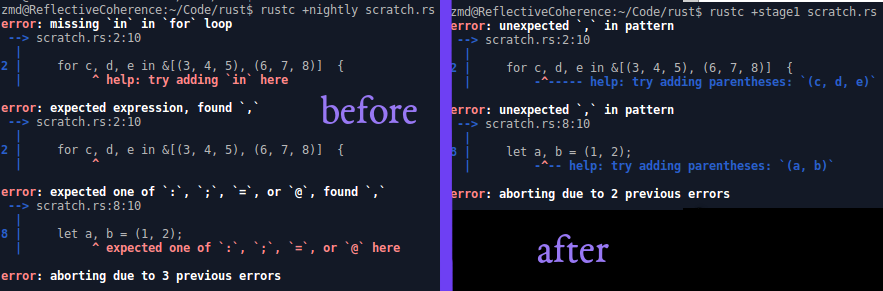 Programmers used to working in some other languages (such as Python or Go) might expect to be able to destructure values with comma-separated identifiers but no parentheses on the left side of an assignment. Previously, the first name in such code would get parsed as a single-indentifier pattern—recognizing, for example, the `let a` in `let a, b = (1, 2);`—whereupon we would have a fatal syntax error on seeing an unexpected comma rather than the expected semicolon (all the way nearer to the end of `parse_full_stmt`). Instead, let's look for that comma when parsing the pattern, and if we see it, make-believe that we're parsing the remaining elements in a tuple pattern, so that we can suggest wrapping it all in parentheses. We need to do this in a separate wrapper method called on a "top-level" pattern, rather than within `parse_pat` itself, because `parse_pat` gets called recursively to parse the sub-patterns within a tuple pattern. ~~We could also do this for `match` arms, `if let`, and `while let`, but we elect not to in this patch, as it seems less likely for users to make the mistake in those contexts.~~ Resolves #48492. r? @petrochenkov
Diffstat (limited to 'src/rustllvm/PassWrapper.cpp')
0 files changed, 0 insertions, 0 deletions