| Age | Commit message (Collapse) | Author | Lines |
|---|
|
Return &T / &mut T in ManuallyDrop Deref(Mut) impl
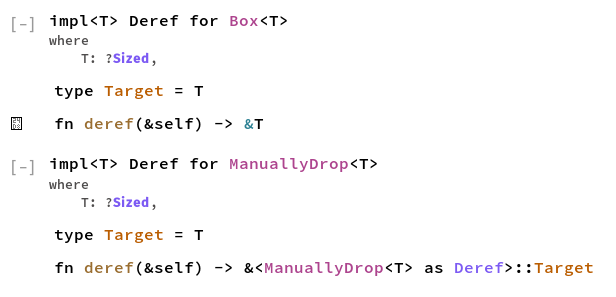
Without this change the generated documentation looks like this:
fn deref(&self) -> &<ManuallyDrop<T> as Deref>::Target
Returning the actual type directly makes the generated docs more clear:
fn deref(&self) -> &T
Basically, compare how the impl for `Box<T>` and `ManuallyDrop<T>` looks in this screenshot:
|
|
Doc total order requirement of sort(_unstable)_by
I took the definition of what a total order is from the Ord trait
docs. I specifically put "elements of the slice" because if you
have a slice of f64s, but know none are NaN, then sorting by
partial ord is total in this case. I'm not sure if I should give
such an example in the docs or not.
r? @GuillaumeGomez
|
|
|
|
|
|
|
|
|
|
|
|
|
|
|
|
|
|
|
|
|
|
Revert #51601
Closes: #55985
Specialization of `StepBy<Range(Inclusive)>` results in an incorrectly behaving code when `step_by` is combined with `skip` or `nth`.
If this will get merged we probably should reopen issues previously closed by #51601 (if there was any).
|
|
avoid shared ref in UnsafeCell::get
Avoid taking a shared reference in `UnsafeCell::get`. This *should* be taking a raw reference (see https://github.com/rust-lang/rfcs/pull/2582), but that operation is not currently available, so I propose we exploit `repr(transparent)` instead and cast the pointer around.
This is required to make `UnsafeCell::get` pass the [stacked borrows implementation](https://www.ralfj.de/blog/2018/11/16/stacked-borrows-implementation.html) in miri (currently, `UnsafeCell::get` is on a whitelist, but that is of course not very satisfying). It shouldn't affect normal execution/codegen. Would be great if we could get this landed and shrink miri's whitelist!
Cc @nikomatsakis
|
|
|
|
core/tests/num: Simplify `test_int_from_str_overflow()` test code
This commit changes the test code to compare against easier-to-read, static values instead of relying on the result of `wrapping_add()` which may or may not result in the value that we expect.
|
|
|
|
|
|
|
|
Remove the parts of atomic::Ordering's intro that wrongly claimed that
SeqCst prevents all reorderings around it.
Closes #55196
|
|
|
|
|
|
core/char: Speed up `to_digit()` for `radix <= 10`
I noticed that `char::to_digit()` seemed to do a bit of extra work for handling `[a-zA-Z]` characters. Since `to_digit(10)` seems to be the most common case (at least in the `rust` codebase) I thought it might be valuable to create a fast path for that case, and according to the benchmarks that I added in one of the commits it seems to pay off. I also created another fast path for the `radix < 10` case, which also seems to have a positive effect.
It is very well possible that I'm measuring something entirely unrelated though, so please verify these numbers and let me know if I missed something!
### Before
```
# Run 1
test char::methods::bench_to_digit_radix_10 ... bench: 16,265 ns/iter (+/- 1,774)
test char::methods::bench_to_digit_radix_16 ... bench: 13,938 ns/iter (+/- 2,479)
test char::methods::bench_to_digit_radix_2 ... bench: 13,090 ns/iter (+/- 524)
test char::methods::bench_to_digit_radix_36 ... bench: 14,236 ns/iter (+/- 1,949)
# Run 2
test char::methods::bench_to_digit_radix_10 ... bench: 16,176 ns/iter (+/- 1,589)
test char::methods::bench_to_digit_radix_16 ... bench: 13,896 ns/iter (+/- 3,140)
test char::methods::bench_to_digit_radix_2 ... bench: 13,158 ns/iter (+/- 1,112)
test char::methods::bench_to_digit_radix_36 ... bench: 14,206 ns/iter (+/- 1,312)
# Run 3
test char::methods::bench_to_digit_radix_10 ... bench: 16,221 ns/iter (+/- 2,423)
test char::methods::bench_to_digit_radix_16 ... bench: 14,361 ns/iter (+/- 3,926)
test char::methods::bench_to_digit_radix_2 ... bench: 13,097 ns/iter (+/- 671)
test char::methods::bench_to_digit_radix_36 ... bench: 14,388 ns/iter (+/- 1,068)
```
### After
```
# Run 1
test char::methods::bench_to_digit_radix_10 ... bench: 11,521 ns/iter (+/- 552)
test char::methods::bench_to_digit_radix_16 ... bench: 12,926 ns/iter (+/- 684)
test char::methods::bench_to_digit_radix_2 ... bench: 11,266 ns/iter (+/- 1,085)
test char::methods::bench_to_digit_radix_36 ... bench: 14,213 ns/iter (+/- 614)
# Run 2
test char::methods::bench_to_digit_radix_10 ... bench: 11,424 ns/iter (+/- 1,042)
test char::methods::bench_to_digit_radix_16 ... bench: 12,854 ns/iter (+/- 1,193)
test char::methods::bench_to_digit_radix_2 ... bench: 11,193 ns/iter (+/- 716)
test char::methods::bench_to_digit_radix_36 ... bench: 14,249 ns/iter (+/- 3,514)
# Run 3
test char::methods::bench_to_digit_radix_10 ... bench: 11,469 ns/iter (+/- 685)
test char::methods::bench_to_digit_radix_16 ... bench: 12,852 ns/iter (+/- 568)
test char::methods::bench_to_digit_radix_2 ... bench: 11,275 ns/iter (+/- 1,356)
test char::methods::bench_to_digit_radix_36 ... bench: 14,188 ns/iter (+/- 1,501)
```
I ran the benchmark using:
```sh
python x.py bench src/libcore --stage 1 --keep-stage 0 --test-args "bench_to_digit"
```
|
|
fix various typos in doc comments
|
|
Add mem::forget_unsized() for forgetting unsized values
~~Allows passing values of `T: ?Sized` types to `mem::drop` and `mem::forget`.~~
Adds `mem::forget_unsized()` that accepts `T: ?Sized`.
I had to revert the PR that removed the `forget` intrinsic and replaced it with `ManuallyDrop`: https://github.com/rust-lang/rust/pull/40559
We can't use `ManuallyDrop::new()` here because it needs `T: Sized` and we don't have support for unsized return values yet (will we ever?).
r? @eddyb
|
|
Add link to std::mem::size_of to size_of intrinsic documentation
The other intrinsics with safe/stable alternatives already have documentation to this effect.
|
|
This commit changes the test code to compare against easier-to-read, static values instead of relying on the result of `wrapping_add()` which may or may not result in the value that we expect.
|
|
|
|
This seems to perform equally well
|
|
|
|
### Before
```
# Run 1
test char::methods::bench_to_digit_radix_10 ... bench: 16,265 ns/iter (+/- 1,774)
test char::methods::bench_to_digit_radix_16 ... bench: 13,938 ns/iter (+/- 2,479)
test char::methods::bench_to_digit_radix_2 ... bench: 13,090 ns/iter (+/- 524)
test char::methods::bench_to_digit_radix_36 ... bench: 14,236 ns/iter (+/- 1,949)
# Run 2
test char::methods::bench_to_digit_radix_10 ... bench: 16,176 ns/iter (+/- 1,589)
test char::methods::bench_to_digit_radix_16 ... bench: 13,896 ns/iter (+/- 3,140)
test char::methods::bench_to_digit_radix_2 ... bench: 13,158 ns/iter (+/- 1,112)
test char::methods::bench_to_digit_radix_36 ... bench: 14,206 ns/iter (+/- 1,312)
# Run 3
test char::methods::bench_to_digit_radix_10 ... bench: 16,221 ns/iter (+/- 2,423)
test char::methods::bench_to_digit_radix_16 ... bench: 14,361 ns/iter (+/- 3,926)
test char::methods::bench_to_digit_radix_2 ... bench: 13,097 ns/iter (+/- 671)
test char::methods::bench_to_digit_radix_36 ... bench: 14,388 ns/iter (+/- 1,068)
```
### After
```
# Run 1
test char::methods::bench_to_digit_radix_10 ... bench: 11,521 ns/iter (+/- 552)
test char::methods::bench_to_digit_radix_16 ... bench: 12,926 ns/iter (+/- 684)
test char::methods::bench_to_digit_radix_2 ... bench: 11,266 ns/iter (+/- 1,085)
test char::methods::bench_to_digit_radix_36 ... bench: 14,213 ns/iter (+/- 614)
# Run 2
test char::methods::bench_to_digit_radix_10 ... bench: 11,424 ns/iter (+/- 1,042)
test char::methods::bench_to_digit_radix_16 ... bench: 12,854 ns/iter (+/- 1,193)
test char::methods::bench_to_digit_radix_2 ... bench: 11,193 ns/iter (+/- 716)
test char::methods::bench_to_digit_radix_36 ... bench: 14,249 ns/iter (+/- 3,514)
# Run 3
test char::methods::bench_to_digit_radix_10 ... bench: 11,469 ns/iter (+/- 685)
test char::methods::bench_to_digit_radix_16 ... bench: 12,852 ns/iter (+/- 568)
test char::methods::bench_to_digit_radix_2 ... bench: 11,275 ns/iter (+/- 1,356)
test char::methods::bench_to_digit_radix_36 ... bench: 14,188 ns/iter (+/- 1,501)
```
|
|
|
|
|
|
|
|
Document optimizations enabled by FusedIterator
When reading this I wondered what “some significant optimizations” referred to. As far as I can tell from reading code, the specialization of `.fuse()` is the only case where `FusedIterator` has any impact at all. Is this accurate @Stebalien?
|
|
Fix typos.
|
|
r=eddyb
Make PhantomData #[structural_match]
fixes https://github.com/rust-lang/rust/issues/55028
This makes `PhantomData<T>` structurally matchable, irrespective of whether `T` is, per the discussion on this week's language team meeting (the general consensus was that this was a bug-fix).
All types containing `PhantomData<T>` and which used `#[derive(PartialEq, Eq)]` and were previously not `#[structural_match]` only because of `PhantomData<T>` will now be `#[structural_match]`.
r? @nikomatsakis
|
|
Use read_unaligned instead of read in transmute_copy
Closes: #55044
This change could result in performance regression on non-x86 platforms. (but it also can fix some of UB which lurks in existing programs) An alternative would be to update `transmute_copy` documentation with alignment requirements.
|
|
Minor standard library constification
This PR makes some bits of the standard library into `const fn`s.
I've tried to be as aggressive as I possibly could in the constification.
The list is rather small due to how restrictive `const fn` is at the moment.
r? @oli-obk cc @rust-lang/libs
Stable public APIs affected:
+ [x] `Cell::as_ptr`
+ [x] `UnsafeCell::get`
+ [x] `char::is_ascii`
+ [x] `iter::empty`
+ [x] `ManuallyDrop::{new, into_inner}`
+ [x] `RangeInclusive::{start, end}`
+ [x] `NonNull::as_ptr`
+ [x] `{[T], str}::as_ptr`
+ [x] `Duration::{as_secs, subsec_millis, subsec_micros, subsec_nanos}`
+ [x] `CStr::as_ptr`
+ [x] `Ipv4Addr::is_unspecified`
+ [x] `Ipv6Addr::new`
+ [x] `Ipv6Addr::octets`
Unstable public APIs affected:
+ [x] `Duration::{as_millis, as_micros, as_nanos, as_float_secs}`
+ [x] `Wrapping::{count_ones, count_zeros, trailing_zeros, rotate_left, rotate_right, swap_bytes, reverse_bits, from_be, from_le, to_be, to_le, leading_zeros, is_positive, is_negative, leading_zeros}`
+ [x] `core::convert::identity`
--------------------------
## Removed from list in first pass:
Stable public APIs affected:
+ [ ] `BTree{Map, Set}::{len, is_empty}`
+ [ ] `VecDeque::is_empty`
+ [ ] `String::{is_empty, len}`
+ [ ] `FromUtf8Error::utf8_error`
+ [ ] `Vec<T>::{is_empty, len}`
+ [ ] `Layout::size`
+ [ ] `DecodeUtf16Error::unpaired_surrogate`
+ [ ] `core::fmt::{fill, width, precision, sign_plus, sign_minus, alternate, sign_aware_zero_pad}`
+ [ ] `panic::Location::{file, line, column}`
+ [ ] `{ChunksExact, RChunksExact}::remainder`
+ [ ] `Utf8Error::valid_up_to`
+ [ ] `VacantEntry::key`
+ [ ] `NulError::nul_position`
+ [ ] `IntoStringError::utf8_error`
+ [ ] `IntoInnerError::error`
+ [ ] `io::Chain::get_ref`
+ [ ] `io::Take::{limit, get_ref}`
+ [ ] `SocketAddrV6::{flowinfo, scope_id}`
+ [ ] `PrefixComponent::{kind, as_os_str}`
+ [ ] `Path::{ancestors, display}`
+ [ ] `WaitTimeoutResult::timed_out`
+ [ ] `Receiver::{iter, try_iter}`
+ [ ] `thread::JoinHandle::thread`
+ [ ] `SystemTimeError::duration`
Unstable public APIs affected:
+ [ ] `core::fmt::Arguments::new_v1`
+ [ ] `core::fmt::Arguments::new_v1_formatted`
+ [ ] `Pin::{get_ref, into_ref}`
+ [ ] `Utf8Lossy::chunks`
+ [ ] `LocalWaker::as_waker`
+ [ ] `panic::PanicInfo::{internal_constructor, message, location}`
+ [ ] `panic::Location::{internal_constructor }`
## Removed from list in 2nd pass:
Stable public APIs affected:
+ [ ] `LinkedList::{new, iter, is_empty, len}`
+ [ ] `mem::forget`
+ [ ] `Cursor::{new, get_ref, position}`
+ [ ] `io::{empty, repeat, sink}`
+ [ ] `PoisonError::new`
+ [ ] `thread::Builder::new`
+ [ ] `process::Stdio::{piped, inherit, null}`
Unstable public APIs affected:
+ [ ] `io::Initializer::{zeroing, should_initialize}`
|
|
|
|
|
|
When reading this I wondered what “some significant optimizations” referred to. As far as I can tell, the specialization of `.fuse()` is the only case where `FusedIterator` has any impact at all. Is this accurate @Stebalien?
|
|
|
|
Fix documentation typos.
|
|
Fix docstring spelling mistakes
|
|
Add missing `rustc_promotable` attribute to unsigned `min_value` and `max_value`
cc @pnkfelix
fixes #55806
|
|
Fix Rc/Arc allocation layout
* Rounds allocation layout up to a multiple of alignment
* Adds a convenience method `Layout::pad_to_align` to perform rounding
Closes #55747
cc #55724
|
|
Implement rotate using funnel shift on LLVM >= 7
Implement the rotate_left and rotate_right operations using
llvm.fshl and llvm.fshr if they are available (LLVM >= 7).
Originally I wanted to expose the funnel_shift_left and
funnel_shift_right intrinsics and implement rotate_left and
rotate_right on top of them. However, emulation of funnel
shifts requires emitting a conditional to check for zero shift
amount, which is not necessary for rotates. I was uncomfortable
doing that here, as I don't want to rely on LLVM to optimize
away that conditional (and for variable rotates, I'm not sure it
can). We should revisit that question when we raise our minimum
version requirement to LLVM 7 and don't need emulation code
anymore.
Fixes #52457.
|
|
|
|
|
