| Age | Commit message (Collapse) | Author | Lines |
|---|
|
|
|
Fixes https://github.com/rust-lang/rust/issues/44479.
|
|
Consistent parameter name for numeric ‘checked’ operations.
Some checked operations use `rhs` as a parameter name, and some use
`other`. For the sake of consistency, unify everything under the `rhs`
name.
Fixes https://github.com/rust-lang/rust/issues/46308.
|
|
Make doc stubs for builtin macros reflect existing support for trailing commas
This modifies the `macro_rules!` stubs in `std` for some of the compiler builtin macros in order to better reflect their currently supported grammar. To my understanding these stubs have no impact on compiler output whatsoever, and only exist so that they may appear in the documentation.
P.S. It is in fact true that `env!` supports trailing commas while `option_env!` currently does not. (I have another issue for this)
I don't imagine there's any way to automatically test these stubs, but I did *informally* test the new definitions on the playpen to see that they accept the desired invocations, as well as inspect the updated doc output.
|
|
Some checked operations use `rhs` as a parameter name, and some use
`other`. For the sake of consistency, unify everything under the `rhs`
name.
Fixes https://github.com/rust-lang/rust/issues/46308.
|
|
The ascii_methods_on_intrinsics feature stabilization
didn't land in time for 1.21.0. Update the annotation
so the documentation is correct about when these
methods became available.
|
|
|
|
Also remove a number of `stage0` annotations and such
|
|
Reject '2' as a binary digit in internals of b: number formatting
The `radix!` macro generates an implementation of the private trait `GenericRadix`, and the code replaced changes Binary's implementation to no longer accept '2' as a valid digit to print.
Granted, this code is literally only ever called from another method in this private trait, and that method has logic to never hand a '2' to the printing function. Even given this, the code's there, I thought it would be best to fix this for clarity of anyone reading it.
|
|
impl From<bool> for AtomicBool
This seems like an obvious omission from #45610. ~~I've used the same feature name and version in the hope that this can be backported to beta so it's stabilized with the other impls. If it can't be I'll change it to `1.24.0`.~~
|
|
Stabilize const-calling existing const-fns in std
Fixes #46038
|
|
Stabilize some `ascii_ctype` methods
As discussed in #39658, this PR stabilizes those methods for `u8` and `char`. All inherent `ascii_ctype` for `[u8]` and `str` are removed as we prefer the more explicit version `s.chars().all(|c| c.is_ascii_())`.
This PR doesn't modify the `AsciiExt` trait. There, the `ascii_ctype` methods are still unstable. It is planned to remove those in the future (I think). I had to modify some code in `ascii.rs` to properly implement `AsciiExt` for all types.
Fixes #39658.
|
|
I don't believe the previous code `0 ... 2` would run into any real problems, but it seems confusing to read, given that '2' is never a valid binary digit.
As far as I can tell this code is only ever called from within another private method in the trait which has logic to never hand it '2' anyways. I thought we could change this for clarity anyways.
|
|
Remove `T: Sized` on `ptr::is_null()`
Originally from #44932 -- this is purely a revert of the last commit of that PR, which was removing some changes from the previous commits in the PR. So a revert of a revert means this is code written by @cuviper!
@mikeyhew makes a compelling case in https://github.com/rust-lang/rfcs/issues/433#issuecomment-345495505 for why this is the right way to implement `is_null` for trait objects. And the behavior for slices makes sense to me as well.
```diff
impl<T: ?Sized> *const T {
- pub fn is_null(self) -> bool where T: Sized;
+ pub fn is_null(self) -> bool;
}
impl<T: ?Sized> *mut T {
- pub fn is_null(self) -> bool where T: Sized;
+ pub fn is_null(self) -> bool;
}
|
|
The changes didn't land in time for 1.23 and stabilizations won't
be backported to beta.
|
|
|
|
Document non-obvious behavior of fmt::UpperHex & co for negative integers
Before stabilization I’d have suggested changing the behavior, but that time is past.
|
|
Expand docs of <$Int>::from_str_radix, based on that of char::to_digit
|
|
Stabilize spin_loop_hint
Stabilize `spin_loop_hint` in release `1.23.0`.
I've also renamed feature `hint_core_should_pause` to `spin_loop_hint`.
cc #41196
|
|
|
|
|
|
Deprecate the Formatter::flags method, fix #46237
This fixes #46237.
|
|
|
|
|
|
Fixes #46038
|
|
Before stabilization I’d have suggested changing the behavior,
but that time is past.
|
|
|
|
core::marker fix typo
|
|
This commit adds compiler support for two basic operations needed for binding
SIMD on x86 platforms:
* First, a `nontemporal_store` intrinsic was added for the `_mm_stream_ps`, seen
in rust-lang-nursery/stdsimd#114. This was relatively straightforward and is
quite similar to the volatile store intrinsic.
* Next, and much more intrusively, a new type to the backend was added. The
`x86_mmx` type is used in LLVM for a 64-bit vector register and is used in
various intrinsics like `_mm_abs_pi8` as seen in rust-lang-nursery/stdsimd#74.
This new type was added as a new layout option as well as having support added
to the trans backend. The type is enabled with the `#[repr(x86_mmx)]`
attribute which is intended to just be an implementation detail of SIMD in
Rust.
I'm not 100% certain about how the `x86_mmx` type was added, so any extra eyes
or thoughts on that would be greatly appreciated!
|
|
|
|
For example, formatting slice of integers with `{:04?}`
should zero-pad each integer.
|
|
|
|
Prevent fmt::Arguments from being shared across threads
Fixes #45197
This is a **breaking change**! Without doing this it's very easy to create race conditions.
There's probably a way to do this without breaking valid use cases, but it would require quite an overhaul of the formatting machinery.
|
|
|
|
|
|
|
|
r=GuillaumeGomez,QuietMisdreavus
show in docs whether the return type of a function impls Iterator/Read/Write
Closes #25928
This PR makes it so that when rustdoc documents a function, it checks the return type to see whether it implements a handful of specific traits. If so, it will print the impl and any associated types. Rather than doing this via a whitelist within rustdoc, i chose to do this by a new `#[doc]` attribute parameter, so things like `Future` could tap into this if desired.
### Known shortcomings
~~The printing of impls currently uses the `where` class over the whole thing to shrink the font size relative to the function definition itself. Naturally, when the impl has a where clause of its own, it gets shrunken even further:~~ (This is no longer a problem because the design changed and rendered this concern moot.)
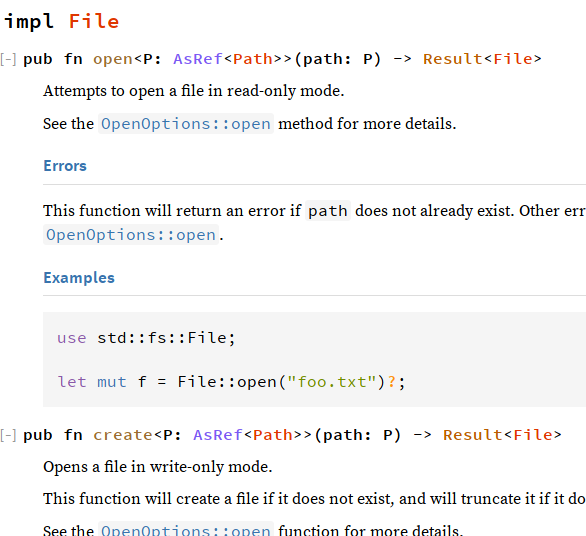
The lookup currently just looks at the top-level type, not looking inside things like Result or Option, which renders the spotlights on Read/Write a little less useful:
<details><summary>`File::{open, create}` don't have spotlight info (pic of old design)</summary>
</details>
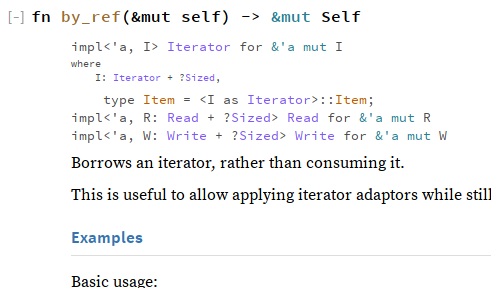
All three of the initially spotlighted traits are generically implemented on `&mut` references. Rustdoc currently treats a `&mut T` reference-to-a-generic as an impl on the reference primitive itself. `&mut Self` counts as a generic in the eyes of rustdoc. All this combines to create this lovely scene on `Iterator::by_ref`:
<details><summary>`Iterator::by_ref` spotlights Iterator, Read, and Write (pic of old design)</summary>
</details>
|
|
Rollup of 9 pull requests
- Successful merges: #46082, #46088, #46092, #46107, #46119, #46121, #46122, #46124, #46128
- Failed merges:
|
|
|
|
Also includes a fix in std::ops
|
|
std: Add a new wasm32-unknown-unknown target
This commit adds a new target to the compiler: wasm32-unknown-unknown. This target is a reimagining of what it looks like to generate WebAssembly code from Rust. Instead of using Emscripten which can bring with it a weighty runtime this instead is a target which uses only the LLVM backend for WebAssembly and a "custom linker" for now which will hopefully one day be direct calls to lld.
Notable features of this target include:
* There is zero runtime footprint. The target assumes nothing exists other than the wasm32 instruction set.
* There is zero toolchain footprint beyond adding the target. No custom linker is needed, rustc contains everything.
* Very small wasm modules can be generated directly from Rust code using this target.
* Most of the standard library is stubbed out to return an error, but anything related to allocation works (aka `HashMap`, `Vec`, etc).
* Naturally, any `#[no_std]` crate should be 100% compatible with this new target.
This target is currently somewhat janky due to how linking works. The "linking" is currently unconditional whole program LTO (aka LLVM is being used as a linker). Naturally that means compiling programs is pretty slow! Eventually though this target should have a linker.
This target is also intended to be quite experimental. I'm hoping that this can act as a catalyst for further experimentation in Rust with WebAssembly. Breaking changes are very likely to land to this target, so it's not recommended to rely on it in any critical capacity yet. We'll let you know when it's "production ready".
### Building yourself
First you'll need to configure the build of LLVM and enable this target
```
$ ./configure --target=wasm32-unknown-unknown --set llvm.experimental-targets=WebAssembly
```
Next you'll want to remove any previously compiled LLVM as it needs to be rebuilt with WebAssembly support. You can do that with:
```
$ rm -rf build
```
And then you're good to go! A `./x.py build` should give you a rustc with the appropriate libstd target.
### Test support
Currently testing-wise this target is looking pretty good but isn't complete. I've got almost the entire `run-pass` test suite working with this target (lots of tests ignored, but many passing as well). The `core` test suite is [still getting LLVM bugs fixed](https://reviews.llvm.org/D39866) to get that working and will take some time. Relatively simple programs all seem to work though!
In general I've only tested this with a local fork that makes use of LLVM 5 rather than our current LLVM 4 on master. The LLVM 4 WebAssembly backend AFAIK isn't broken per se but is likely missing bug fixes available on LLVM 5. I'm hoping though that we can decouple the LLVM 5 upgrade and adding this wasm target!
### But the modules generated are huge!
It's worth nothing that you may not immediately see the "smallest possible wasm module" for the input you feed to rustc. For various reasons it's very difficult to get rid of the final "bloat" in vanilla rustc (again, a real linker should fix all this). For now what you'll have to do is:
cargo install --git https://github.com/alexcrichton/wasm-gc
wasm-gc foo.wasm bar.wasm
And then `bar.wasm` should be the smallest we can get it!
---
In any case for now I'd love feedback on this, particularly on the various integration points if you've got better ideas of how to approach them!
|
|
Add RefCell<T>::replace_with
I also moved the `Panic` sections to before examples in the other two functions also under this feature gate, and changed the variable names in `replace` to be more readable.
r? @rust-libs
|
|
This commit adds a new target to the compiler: wasm32-unknown-unknown. This
target is a reimagining of what it looks like to generate WebAssembly code from
Rust. Instead of using Emscripten which can bring with it a weighty runtime this
instead is a target which uses only the LLVM backend for WebAssembly and a
"custom linker" for now which will hopefully one day be direct calls to lld.
Notable features of this target include:
* There is zero runtime footprint. The target assumes nothing exists other than
the wasm32 instruction set.
* There is zero toolchain footprint beyond adding the target. No custom linker
is needed, rustc contains everything.
* Very small wasm modules can be generated directly from Rust code using this
target.
* Most of the standard library is stubbed out to return an error, but anything
related to allocation works (aka `HashMap`, `Vec`, etc).
* Naturally, any `#[no_std]` crate should be 100% compatible with this new
target.
This target is currently somewhat janky due to how linking works. The "linking"
is currently unconditional whole program LTO (aka LLVM is being used as a
linker). Naturally that means compiling programs is pretty slow! Eventually
though this target should have a linker.
This target is also intended to be quite experimental. I'm hoping that this can
act as a catalyst for further experimentation in Rust with WebAssembly. Breaking
changes are very likely to land to this target, so it's not recommended to rely
on it in any critical capacity yet. We'll let you know when it's "production
ready".
---
Currently testing-wise this target is looking pretty good but isn't complete.
I've got almost the entire `run-pass` test suite working with this target (lots
of tests ignored, but many passing as well). The `core` test suite is still
getting LLVM bugs fixed to get that working and will take some time. Relatively
simple programs all seem to work though!
---
It's worth nothing that you may not immediately see the "smallest possible wasm
module" for the input you feed to rustc. For various reasons it's very difficult
to get rid of the final "bloat" in vanilla rustc (again, a real linker should
fix all this). For now what you'll have to do is:
cargo install --git https://github.com/alexcrichton/wasm-gc
wasm-gc foo.wasm bar.wasm
And then `bar.wasm` should be the smallest we can get it!
---
In any case for now I'd love feedback on this, particularly on the various
integration points if you've got better ideas of how to approach them!
|
|
This reverts commit 604f049cd5060129cf14f7bd340d442811345ea8.
This is purely a revert of cuviper's revert "Restore `T: Sized` on
`ptr::is_null`". So double revert means this is code written by cuviper!
|
|
The feature of those methods was renamed to "ascii_ctype_on_intrinsics".
|
|
|
|
|
|
|
|
Short-circuiting internal iteration with Iterator::try_fold & try_rfold
These are the core methods in terms of which the other methods (`fold`, `all`, `any`, `find`, `position`, `nth`, ...) can be implemented, allowing Iterator implementors to get the full goodness of internal iteration by only overriding one method (per direction).
Based off the `Try` trait, so works with both `Result` and `Option` (:tada: https://github.com/rust-lang/rust/pull/42526). The `try_fold` rustdoc examples use `Option` and the `try_rfold` ones use `Result`.
AKA continuing in the vein of PRs https://github.com/rust-lang/rust/pull/44682 & https://github.com/rust-lang/rust/pull/44856 for more of `Iterator`.
New bench following the pattern from the latter of those:
```
test iter::bench_take_while_chain_ref_sum ... bench: 1,130,843 ns/iter (+/- 25,110)
test iter::bench_take_while_chain_sum ... bench: 362,530 ns/iter (+/- 391)
```
I also ran the benches without the `fold` & `rfold` overrides to test their new default impls, with basically no change. I left them there, though, to take advantage of existing overrides and because `AlwaysOk` has some sub-optimality due to https://github.com/rust-lang/rust/issues/43278 (which 45225 should fix).
If you're wondering why there are three type parameters, see issue https://github.com/rust-lang/rust/issues/45462
Thanks for @bluss for the [original IRLO thread](https://internals.rust-lang.org/t/pre-rfc-fold-ok-is-composable-internal-iteration/4434) and the rfold PR and to @cuviper for adding so many folds, [encouraging me](https://github.com/rust-lang/rust/pull/45379#issuecomment-339424670) to make this PR, and finding a catastrophic bug in a pre-review.
|
|
Fixed several pulldown warnings when documenting libstd.
|
