| Age | Commit message (Collapse) | Author | Lines |
|---|
|
|
|
Use more compatible out-implib style
When calling `rust-lld` directly it accepts only `--out-implib {}` or `--out-implib={}` not `--out-implib,{}`.
|
|
|
|
|
|
Add sanitizer support on FreeBSD
Restarting #47337. Everything is better now, no more weird llvm problems, well not everything:
Unfortunately, the sanitizers don't have proper support for versioned symbols (https://github.com/google/sanitizers/issues/628), so `libc`'s usage of `stat@FBSD_1.0` and so on explodes, e.g. in calling `std::fs::metadata`.
Building std (now easy thanks to cargo `-Zbuild-std`) and libc with `freebsd12/13` config via the `LIBC_CI=1` env variable is a good workaround…
```
LIBC_CI=1 RUSTFLAGS="-Z sanitizer=address" cargo +san-test -Zbuild-std run --target x86_64-unknown-freebsd --verbose
```
…*except* std won't build because there's no `st_lspare` in the ino64 version of the struct, so an std patch is required:
```diff
--- i/src/libstd/os/freebsd/fs.rs
+++ w/src/libstd/os/freebsd/fs.rs
@@ -66,8 +66,6 @@ pub trait MetadataExt {
fn st_flags(&self) -> u32;
#[stable(feature = "metadata_ext2", since = "1.8.0")]
fn st_gen(&self) -> u32;
- #[stable(feature = "metadata_ext2", since = "1.8.0")]
- fn st_lspare(&self) -> u32;
}
#[stable(feature = "metadata_ext", since = "1.1.0")]
@@ -136,7 +134,4 @@ impl MetadataExt for Metadata {
fn st_flags(&self) -> u32 {
self.as_inner().as_inner().st_flags as u32
}
- fn st_lspare(&self) -> u32 {
- self.as_inner().as_inner().st_lspare as u32
- }
}
```
I guess std could like.. detect that `libc` isn't built for the old ABI, and replace the implementation of `st_lspare` with a panic?
|
|
merge `as_local_hir_id` with `local_def_id_to_hir_id`
`as_local_hir_id` was defined as just calling `local_def_id_to_hir_id` and I think that having two different ways to call the same method is somewhat confusing.
Don't really care about which of these 2 methods we want to keep.
Does this require an MCP, considering that these methods are fairly frequently used?
|
|
Remove most specialization use in serialization
Switching from specialization to min_specialization in the compiler made the unsoundness of how we used these traits pretty clear. This changes how the `Encodable` and `Decodable` traits work to be more friendly for types need a `TyCtxt` to deserialize.
The alternative design of having both `Encodable` and `TyEncodable` traits was considered, but doesn't really work because the following impls would conflict:
```
impl<E: Ecodable> TyEncodable for Encodable
impl<E: TyEcodable> TyEncodable for [E]
```
## How-to guide
- `Rustc(De|En)codable` is now spelled `Ty(De|En)coable` in `rustc_middle`, `Metadata(En|De)codable` in `rustc_metadata` where needed, and `(De|En)codable` everywhere else.
- Manual implementations of `(De|En)codable` shouldn't be much different.
- If you're adding a new interned type that needs to be en/decodable then the simplest thing way to handle this is:
- Have the type be a wrapper around a reference to the interned data (i.e. do what `ty::Predicate` does, and not what all of the other interned types do)
- Derive `Ty(En|De)codable` on the inner type
- Implement `Encodable<impl TyEncoder>` by forwarding to the inner type.
- Implement `Decodable<impl TyDecoder>` by decoding the inner type and then creating the wrapper around that (using the `tcx` from the decoder as needed).
cc @rust-lang/compiler for opinions on this change
r? @oli-obk
|
|
- Move the type parameter from `encode` and `decode` methods to
the trait.
- Remove `UseSpecialized(En|De)codable` traits.
- Remove blanket impls for references.
- Add `RefDecodable` trait to allow deserializing to arena-allocated
references safely.
- Remove ability to (de)serialize HIR.
- Create proc-macros `(Ty)?(En|De)codable` to help implement these new
traits.
|
|
LLVM IR coverage encoding aligns closer to Clang's
I found some areas for improvement while attempting to debug the
SegFault issue when running rust programs compiled using MSVC, with
coverage instrumentation.
I discovered that LLVM's coverage writer was generating incomplete
function name variable names (that's not a typo: the name of the
variable that holds a function name).
The existing implementation used one-up numbers to distinguish
variables, and correcting the names did not fix the MSVC coverage bug,
but the fix in this PR makes the names and resulting LLVM IR easier to
follow and more consistent with Clang's implementation.
I also changed the way the `-Zinstrument-coverage` option is supported in
symbol_export.rs. The original implementation was incorrect, and the
corrected version matches the handling for `-Zprofile-generate`, as it
turns out.
(An argument could be made that maybe `-Zinstrument-coverage` should
automatically enable `-Cprofile-generate`. In fact, if
`-Cprofile-generate` is analagous to Clang's `-fprofile-generate`, as
some documentation implies, Clang always requires this flag for its
implementation of source-based code coverage. This would require a
little more validation, and if implemented, would probably require
updating some of the user-facing messages related to
`-Cprofile-generate` to not be so specific to the PGO use case.)
None of these changes fixed the MSVC coverage problems, but they should
still be welcome improvements.
Lastly, I added some additional FIXME comments in instrument_coverage.rs
describing issues I found with the generated LLVM IR that would be
resolved if the coverage instrumentation is injected with a `Statement`
instead of as a new `BasicBlock`. I describe seven advantages of this
change, but it requires some discussion before making a change like
this.
r? @tmandry
|
|
I found some areas for improvement while attempting to debug the
SegFault issue when running rust programs compiled using MSVC, with
coverage instrumentation.
I discovered that LLVM's coverage writer was generating incomplete
function name variable names (that's not a typo: the name of the
variable that holds a function name).
The existing implementation used one-up numbers to distinguish
variables, and correcting the names did not fix the MSVC coverage bug,
but the fix in this PR makes the names and resulting LLVM IR easier to
follow and more consistent with Clang's implementation.
I also changed the way the `-Zinstrument-coverage` option is supported
in symbol_export.rs. The original implementation was incorrect, and the
corrected version matches the handling for `-Zprofile-generate`, as it
turns out.
(An argument could be made that maybe `-Zinstrument-coverage` should
automatically enable `-Cprofile-generate`. In fact, if
`-Cprofile-generate` is analagous to Clang's `-fprofile-generate`, as
some documentation implies, Clang always requires this flag for its
implementation of source-based code coverage. This would require a
little more validation, and if implemented, would probably require
updating some of the user-facing messages related to
`-Cprofile-generate` to not be so specific to the PGO use case.)
None of these changes fixed the MSVC coverage problems, but they should
still be welcome improvements.
Lastly, I added some additional FIXME comments in instrument_coverage.rs
describing issues I found with the generated LLVM IR that would be
resolved if the coverage instrumentation is injected with a `Statement`
instead of as a new `BasicBlock`. I describe seven advantages of this
change, but it requires some discussion before making a change like
this.
|
|
|
|
|
|
Avoid deleting temporary files on error
Previously if the compiler error'd, fatally, then temporary directories which
should be preserved by -Csave-temps would be deleted due to fatal compiler
errors being implemented as panics.
cc @infinity0
(Hopefully) fixes #75275, but I haven't tested
|
|
r=petrochenkov
MinGW: disable self-contained mode when cross compiling
When cross compiling users have to provide own linker and libraries anyway.
Using rust provided MinGW crt objects is harmful here and has no benefits.
cc https://github.com/rust-lang/rust/issues/68887
|
|
|
|
Previously if the compiler error'd, fatally, then temporary directories which
should be preserved by -Csave-temps would be deleted due to fatal compiler
errors being implemented as panics.
|
|
Remove `librustc_ast` session globals
By moving the data onto `Session`.
r? @petrochenkov
|
|
By moving `{known,used}_attrs` from `SessionGlobals` to `Session`. This
means they are accessed via the `Session`, rather than via TLS. A few
`Attr` methods and `librustc_ast` functions are now methods of
`Session`.
All of this required passing a `Session` to lots of functions that didn't
already have one. Some of these functions also had arguments removed, because
those arguments could be accessed directly via the `Session` argument.
`contains_feature_attr()` was dead, and is removed.
Some functions were moved from `librustc_ast` elsewhere because they now need
to access `Session`, which isn't available in that crate.
- `entry_point_type()` --> `librustc_builtin_macros`
- `global_allocator_spans()` --> `librustc_metadata`
- `is_proc_macro_attr()` --> `Session`
|
|
|
|
MinGW: enable dllexport/dllimport
Fixes (only when using LLD) https://github.com/rust-lang/rust/issues/50176
Fixes https://github.com/rust-lang/rust/issues/72319
This makes `windows-gnu` on pair with `windows-msvc` when it comes to symbol exporting.
For MinGW it means both good things like correctly working dllimport/dllexport, ability to link with LLD and bad things like https://github.com/rust-lang/rust/issues/27438.
Not sure but maybe this should land behind unstable compiler option (`-Z`) or environment variable?
|
|
This fixes various cases where LD could not guess dllexport correctly and greatly improves compatibility with LLD which is not going to support linker scripts anytime soon
|
|
rustc_target: Add a target spec option for disabling `--eh-frame-hdr`
Disable `--eh-frame-hdr` for targets that use an `ld`-like linker, but don't support that option.
Do it through a target spec option rather than through hard-coding in `linker.rs`.
The option is still enabled by default though.
cc https://github.com/rust-lang/rust/pull/73564
Fixes https://github.com/rust-lang/rust/pull/73564#issuecomment-657011004
Fixes https://github.com/rust-lang/rust/pull/74625
Fixes https://github.com/rust-embedded/msp430-rt/issues/12
|
|
Stabilize control-flow-guard codegen option
This is the stabilization PR discussed in #68793. It converts the `-Z control-flow-guard` debugging option into a codegen option (`-C control-flow-guard`), and changes the associated tests.
|
|
|
|
Generating the coverage map
@tmandry @wesleywiser
rustc now generates the coverage map and can support (limited)
coverage report generation, at the function level.
Example commands to generate a coverage report:
```shell
$ BUILD=$HOME/rust/build/x86_64-unknown-linux-gnu
$ $BUILD/stage1/bin/rustc -Zinstrument-coverage \
$HOME/rust/src/test/run-make-fulldeps/instrument-coverage/main.rs
$ LLVM_PROFILE_FILE="main.profraw" ./main
called
$ $BUILD/llvm/bin/llvm-profdata merge -sparse main.profraw -o main.profdata
$ $BUILD/llvm/bin/llvm-cov show --instr-profile=main.profdata main
```
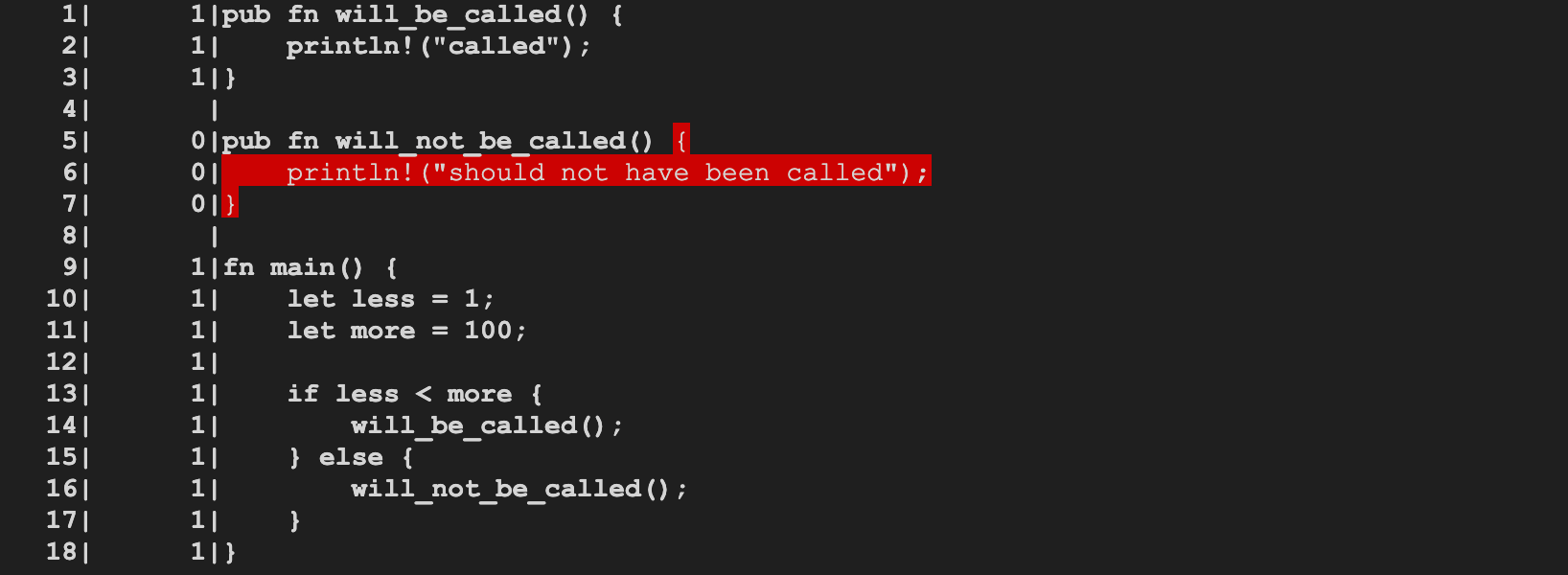
r? @wesleywiser
Rust compiler MCP rust-lang/compiler-team#278
Relevant issue: #34701 - Implement support for LLVMs code coverage instrumentation
|
|
r=Mark-Simulacrum
Revert "Use an UTF-8 locale for the linker."
Reverts rust-lang/rust#74416
This is suspected to have caused significant compile time regressions: https://perf.rust-lang.org/compare.html?start=39d5a61f2e4e237123837f5162cc275c2fd7e625&end=d3df8512d2c2afc6d2e7d8b5b951dd7f2ad77b02&stat=instructions:u
|
|
|
|
Use pathdiff crate
I wanted to tackle a simple issue, and stumbled upon #67108: this pr removes the function which was exported to the external crate as required in the todo/issue.
I've tested it with:
```
./x.py build --stage 1 --keep-stage 1 src/librustc_codegen_ssa
```
And it looks like it's compiling
|
|
|
|
|
|
rustc now generates the coverage map and can support (limited)
coverage report generation, at the function level.
Example:
$ BUILD=$HOME/rust/build/x86_64-unknown-linux-gnu
$ $BUILD/stage1/bin/rustc -Zinstrument-coverage \
$HOME/rust/src/test/run-make-fulldeps/instrument-coverage/main.rs
$ LLVM_PROFILE_FILE="main.profraw" ./main
called
$ $BUILD/llvm/bin/llvm-profdata merge -sparse main.profraw -o main.profdata
$ $BUILD/llvm/bin/llvm-cov show --instr-profile=main.profdata main
1| 1|pub fn will_be_called() {
2| 1| println!("called");
3| 1|}
4| |
5| 0|pub fn will_not_be_called() {
6| 0| println!("should not have been called");
7| 0|}
8| |
9| 1|fn main() {
10| 1| let less = 1;
11| 1| let more = 100;
12| 1|
13| 1| if less < more {
14| 1| will_be_called();
15| 1| } else {
16| 1| will_not_be_called();
17| 1| }
18| 1|}
|
|
|
|
When cross compiling users have to provide own linker and libraries anyway.
Using rust provided MinGW crt objects is harmful here and has no benefits.
|
|
Support const args in type dependent paths (Take 2)
once more, except it is sound this time :smiling_face_with_three_hearts: previously #71154
-----
```rust
#![feature(const_generics)]
struct A;
impl A {
fn foo<const N: usize>(&self) -> usize { N }
}
struct B;
impl B {
fn foo<const N: usize>(&self) -> usize { 42 }
}
fn main() {
let a = A;
a.foo::<7>();
}
```
When calling `type_of` for generic const arguments, we now use the `TypeckTables` of the surrounding body to get the expected type.
This alone causes cycle errors though, as we now have `typeck_tables_of(main)` -> `...` ->
`type_of(main_ANON0 := 7)` -> `typeck_tables_of(main)` :zap: (see https://github.com/rust-lang/rust/issues/68400#issuecomment-611760290)
To prevent this we must not call `type_of(const_arg)` during `typeck_tables_of`. This is achieved by
calling `type_of(param_def_id)` instead.
We have to somehow remember the `DefId` of the param through all of typeck, which is done using the
struct `ty::WithOptConstParam<DefId>`, which replaces `DefId` where needed and contains an `Option<DefId>` to
be able to store the const parameter in case it exists.
Queries which are currently cached on disk are split into two variants: `query_name`(cached) and `query_name_(of|for)_const_arg`(not cached), with `query_name_of_const_arg` taking a pair `(did, param_did): (LocalDefId, DefId)`.
For some queries a method `query_name_of_opt_const_arg` is added to `TyCtxt` which takes a `ty::WithOptConstParam` and either calls `query_name` or `query_name_of_const_arg` depending on the value of `const_param_did`.
r? @eddyb @varkor
|
|
|
|
This eliminates a bunch of `Symbol::intern()` and `Symbol::as_str()`
calls, which is good, because they require locking the interner.
Note that the unsafety in `from_cycle_error()` is identical to the
unsafety on other adjacent impls.
|
|
Note that the output of `unpretty-debug.stdout` has changed. In that
test the hash values are normalized from a symbol numbers to small
numbers like "0#0" and "0#1". The increase in the number of static
symbols must have caused the original numbers to contain more digits,
resulting in different pretty-printing prior to normalization.
|
|
|
|
linker: illumos ld does not support --eh-frame-hdr
As of rust-lang/rust#73564, the --eh-frame-hdr flag is unconditionally
passed to linkers on many platforms. The illumos link editor does not
currently support this flag.
The linker machinery in the Rust toolchain currently seems to use the
(potentially cross-compiled) target to choose linker flags, rather than
looking at what might be running on the build system. Disabling the
flag for all illumos/Solaris targets seems like the best we can do for
now without more serious surgery.
|
|
Avoid "whitelist"
Other terms are more inclusive and precise.
|
|
Only add CFGuard on `windows-msvc` targets
As @ollie27 pointed out in #73893, the `cfguard` module flag causes incorrect behavior on `windows-gnu` targets. This patch restricts rustc to only add this flag for `windows-msvc` targets (this may need to be changed if other linkers gain support for CFGuard).
|
|
Other terms are more inclusive and precise.
|
|
|
|
As of rust-lang/rust#73564, the --eh-frame-hdr flag is unconditionally
passed to linkers on many platforms. The illumos link editor does not
currently support this flag.
The linker machinery in the Rust toolchain currently seems to use the
(potentially cross-compiled) target to choose linker flags, rather than
looking at what might be running on the build system. Disabling the
flag for all illumos/Solaris targets seems like the best we can do for
now without more serious surgery.
|
|
|
|
|
|
Self contained linking option
With objects moved to self-contained directory by https://github.com/rust-lang/rust/pull/72999 we can now add option to control whether to use self-contained on native linkage mode.
|
|
|
|
|
|
|
