| Age | Commit message (Collapse) | Author | Lines |
|---|
|
|
|
Unify error reporting for intra-doc links
- Give a suggestion even if there is no span available
- Give a more accurate description of the change than 'use the
disambiguator'
- Write much less code
Closes #75836.
r? @euclio
cc @pickfire - this gets rid of 'disambiguator' like you suggested in https://github.com/rust-lang/rust/pull/75079#discussion_r464464195.
|
|
|
|
Co-authored-by: Ivan Tham <pickfire@riseup.net>
|
|
|
|
|
|
This commit adjusts the naming of various lang items so that they are
consistent and don't include prefixes containing the target or
"LangItem". In addition, lang item variants are no longer exported from
the `lang_items` module.
Signed-off-by: David Wood <david@davidtw.co>
|
|
Use smaller def span for functions
Currently, the def span of a function encompasses the entire function
signature and body. However, this is usually unnecessarily verbose - when we are
pointing at an entire function in a diagnostic, we almost always want to
point at the signature. The actual contents of the body tends to be
irrelevant to the diagnostic we are emitting, and just takes up
additional screen space.
This commit changes the `def_span` of all function items (freestanding
functions, `impl`-block methods, and `trait`-block methods) to be the
span of the signature. For example, the function
```rust
pub fn foo<T>(val: T) -> T { val }
```
now has a `def_span` corresponding to `pub fn foo<T>(val: T) -> T`
(everything before the opening curly brace).
Trait methods without a body have a `def_span` which includes the
trailing semicolon. For example:
```rust
trait Foo {
fn bar();
}
```
the function definition `Foo::bar` has a `def_span` of `fn bar();`
This makes our diagnostic output much shorter, and emphasizes
information that is relevant to whatever diagnostic we are reporting.
We continue to use the full span (including the body) in a few of
places:
* MIR building uses the full span when building source scopes.
* 'Outlives suggestions' use the full span to sort the diagnostics being
emitted.
* The `#[rustc_on_unimplemented(enclosing_scope="in this scope")]`
attribute points the entire scope body.
All of these cases work only with local items, so we don't need to
add anything extra to crate metadata.
|
|
Currently, the def span of a funtion encompasses the entire function
signature and body. However, this is usually unnecessarily verbose - when we are
pointing at an entire function in a diagnostic, we almost always want to
point at the signature. The actual contents of the body tends to be
irrelevant to the diagnostic we are emitting, and just takes up
additional screen space.
This commit changes the `def_span` of all function items (freestanding
functions, `impl`-block methods, and `trait`-block methods) to be the
span of the signature. For example, the function
```rust
pub fn foo<T>(val: T) -> T { val }
```
now has a `def_span` corresponding to `pub fn foo<T>(val: T) -> T`
(everything before the opening curly brace).
Trait methods without a body have a `def_span` which includes the
trailing semicolon. For example:
```rust
trait Foo {
fn bar();
}```
the function definition `Foo::bar` has a `def_span` of `fn bar();`
This makes our diagnostic output much shorter, and emphasizes
information that is relevant to whatever diagnostic we are reporting.
We continue to use the full span (including the body) in a few of
places:
* MIR building uses the full span when building source scopes.
* 'Outlives suggestions' use the full span to sort the diagnostics being
emitted.
* The `#[rustc_on_unimplemented(enclosing_scope="in this scope")]`
attribute points the entire scope body.
* The 'unconditional recursion' lint uses the full span to show
additional context for the recursive call.
All of these cases work only with local items, so we don't need to
add anything extra to crate metadata.
|
|
|
|
|
|
rust_ast::ast => rustc_ast
Rework of #71199 which is a rework #70621
Still working on this but just made the PR to track progress
r? @Dylan-DPC
|
|
|
|
This commit simplifies `is_range_literal` by checking for
`QPath::LangItem` containing range-related lang items, rather than using
a heuristic.
Co-authored-by: Matthew Jasper <mjjasper1@gmail.com>
Signed-off-by: David Wood <david@davidtw.co>
|
|
This commit introduces `QPath::LangItem` to the HIR and uses it in AST
lowering instead of constructing a `hir::Path` from a slice of symbols.
This might be better for performance, but is also much cleaner as the
previous approach is fragile. In addition, it resolves a bug (#61019)
where an extern crate imported as "std" would result in the paths
created during AST lowering being resolved incorrectly (or not at all).
Co-authored-by: Matthew Jasper <mjjasper1@gmail.com>
Signed-off-by: David Wood <david@davidtw.co>
|
|
This commit adds new lang items which will be used in AST lowering once
`QPath::LangItem` is introduced.
Co-authored-by: Matthew Jasper <mjjasper1@gmail.com>
Signed-off-by: David Wood <david@davidtw.co>
|
|
This commit adds support for lang items (`#[lang = "..."]` attributes)
on enum variants.
Signed-off-by: David Wood <david@davidtw.co>
|
|
|
|
merge `as_local_hir_id` with `local_def_id_to_hir_id`
`as_local_hir_id` was defined as just calling `local_def_id_to_hir_id` and I think that having two different ways to call the same method is somewhat confusing.
Don't really care about which of these 2 methods we want to keep.
Does this require an MCP, considering that these methods are fairly frequently used?
|
|
|
|
- Move the type parameter from `encode` and `decode` methods to
the trait.
- Remove `UseSpecialized(En|De)codable` traits.
- Remove blanket impls for references.
- Add `RefDecodable` trait to allow deserializing to arena-allocated
references safely.
- Remove ability to (de)serialize HIR.
- Create proc-macros `(Ty)?(En|De)codable` to help implement these new
traits.
|
|
|
|
This creates the language item for arrays, and adds the map fn which is like map in options or
iterators. It currently allocates an extra array, unfortunately.
Added fixme for transmuting
Fix typo
Add drop guard
|
|
|
|
By moving `{known,used}_attrs` from `SessionGlobals` to `Session`. This
means they are accessed via the `Session`, rather than via TLS. A few
`Attr` methods and `librustc_ast` functions are now methods of
`Session`.
All of this required passing a `Session` to lots of functions that didn't
already have one. Some of these functions also had arguments removed, because
those arguments could be accessed directly via the `Session` argument.
`contains_feature_attr()` was dead, and is removed.
Some functions were moved from `librustc_ast` elsewhere because they now need
to access `Session`, which isn't available in that crate.
- `entry_point_type()` --> `librustc_builtin_macros`
- `global_allocator_spans()` --> `librustc_metadata`
- `is_proc_macro_attr()` --> `Session`
|
|
|
|
|
|
|
|
Generating the coverage map
@tmandry @wesleywiser
rustc now generates the coverage map and can support (limited)
coverage report generation, at the function level.
Example commands to generate a coverage report:
```shell
$ BUILD=$HOME/rust/build/x86_64-unknown-linux-gnu
$ $BUILD/stage1/bin/rustc -Zinstrument-coverage \
$HOME/rust/src/test/run-make-fulldeps/instrument-coverage/main.rs
$ LLVM_PROFILE_FILE="main.profraw" ./main
called
$ $BUILD/llvm/bin/llvm-profdata merge -sparse main.profraw -o main.profdata
$ $BUILD/llvm/bin/llvm-cov show --instr-profile=main.profdata main
```
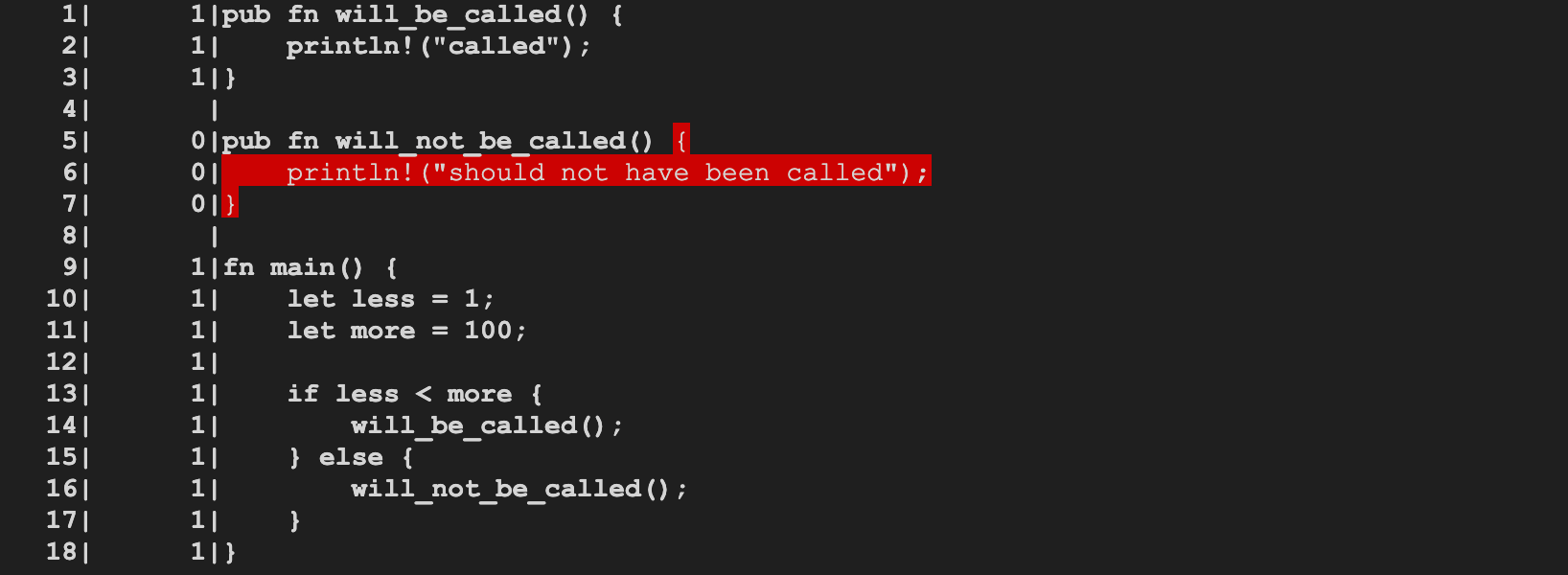
r? @wesleywiser
Rust compiler MCP rust-lang/compiler-team#278
Relevant issue: #34701 - Implement support for LLVMs code coverage instrumentation
|
|
rustc now generates the coverage map and can support (limited)
coverage report generation, at the function level.
Example:
$ BUILD=$HOME/rust/build/x86_64-unknown-linux-gnu
$ $BUILD/stage1/bin/rustc -Zinstrument-coverage \
$HOME/rust/src/test/run-make-fulldeps/instrument-coverage/main.rs
$ LLVM_PROFILE_FILE="main.profraw" ./main
called
$ $BUILD/llvm/bin/llvm-profdata merge -sparse main.profraw -o main.profdata
$ $BUILD/llvm/bin/llvm-cov show --instr-profile=main.profdata main
1| 1|pub fn will_be_called() {
2| 1| println!("called");
3| 1|}
4| |
5| 0|pub fn will_not_be_called() {
6| 0| println!("should not have been called");
7| 0|}
8| |
9| 1|fn main() {
10| 1| let less = 1;
11| 1| let more = 100;
12| 1|
13| 1| if less < more {
14| 1| will_be_called();
15| 1| } else {
16| 1| will_not_be_called();
17| 1| }
18| 1|}
|
|
Rename TypeckTables to TypeckResults.
Originally suggested by @eddyb.
|
|
|
|
Bump version to 1.47
This also bumps to a more recent rustfmt version, just to keep us relatively up to date (though almost nothing has changed in rustfmt we use beyond bumps to the parser infra). No formatting changes as a result of this.
r? @pietroalbini
|
|
|
|
|
|
This now reuses `fn discriminant_ty` in project, removing
some code duplication. Doing so made me realize that
we previously had a disagreement about the discriminant
type of generators, with MIR using `u32` and codegen and
trait selection using `i32`.
We now always use `u32`.
|
|
More static symbols
These commits add some more static symbols and convert lots of places to use them.
r? @oli-obk
|
|
Note that the output of `unpretty-debug.stdout` has changed. In that
test the hash values are normalized from a symbol numbers to small
numbers like "0#0" and "0#1". The increase in the number of static
symbols must have caused the original numbers to contain more digits,
resulting in different pretty-printing prior to normalization.
|
|
|
|
|
|
This is a re-attempt of #72389 (which was reverted in #73594)
Instead of using `ExpnKind::Desugaring` to represent operators, this PR
checks the lang item directly.
|
|
Fixes #70718
This commit allows making associated items (e.g. associated functions
and types) into lang items via the `#[lang]` attribute. This allows such
items to be accessed directly, rather than by iterating over the parent
item's associated items.
I've added `FnOnce::Output` as a lang item, and updated one old usage to
use the new lang item. The remaining uses can be updated separately.
|
|
Change heuristic for determining range literal
Currently, rustc uses a heuristic to determine if a range expression is
not a literal based on whether the expression looks like a function call
or struct initialization. This fails for range literals whose
lower/upper bounds are the results of function calls. A possibly-better
heuristic is to check if the expression contains `..`, required in range
literals.
Of course, this is also not perfect; for example, if the range
expression is a struct which includes some text with `..` this will
fail, but in general I believe it is a better heuristic.
A better alternative altogether is to add the `QPath::LangItem` enum
variant suggested in #60607. I would be happy to do this as a precursor
to this patch if someone is able to provide general suggestions on how
usages of `QPath` need to be changed later in the compiler with the
`LangItem` variant.
Closes #73553
|
|
Currently, rustc uses a heuristic to determine if a range expression is
not a literal based on whether the expression looks like a function call
or struct initialization. This fails for range literals whose
lower/upper bounds are the results of function calls. A possibly-better
heuristic is to check if the expression contains `..`, required in range
literals.
Of course, this is also not perfect; for example, if the range
expression is a struct which includes some text with `..` this will
fail, but in general I believe it is a better heuristic.
A better alternative altogether is to add the `QPath::LangItem` enum
variant suggested in #60607. I would be happy to do this as a precursor
to this patch if someone is able to provide general suggestions on how
usages of `QPath` need to be changed later in the compiler with the
`LangItem` variant.
Closes #73553
|
|
|
|
|
|
|
|
|
|
|
|
|
