| Age | Commit message (Collapse) | Author | Lines |
|---|
|
|
|
Fixes #75144
|
|
|
|
|
|
|
|
Rollup of 8 pull requests
Successful merges:
- #75672 (Move to intra-doc links for task.rs and vec.rs)
- #75702 (Clean up E0759 explanation)
- #75703 (Enable stack-overflow detection on musl for non-main threads)
- #75710 (Fix bad printing of const-eval queries)
- #75716 (Upgrade Emscripten on CI to 1.39.20 )
- #75731 (Suppress ty::Float in MIR comments of ty::Const)
- #75733 (Remove duplicated alloc vec bench push_all_move)
- #75743 (Rename rustc_lexer::TokenKind::Not to Bang)
Failed merges:
r? @ghost
|
|
Fix bad printing of const-eval queries
Fixes: #75447
r? @RalfJung
cc @oli-obk
|
|
Check that we don't use `Rvalue::Aggregate` after the deaggregator
fixes #75481
r? @wesleywiser
cc @RalfJung (modified the validator)
|
|
Co-authored-by: Wesley Wiser <wwiser@gmail.com>
|
|
|
|
|
|
|
|
|
|
|
|
merge `as_local_hir_id` with `local_def_id_to_hir_id`
`as_local_hir_id` was defined as just calling `local_def_id_to_hir_id` and I think that having two different ways to call the same method is somewhat confusing.
Don't really care about which of these 2 methods we want to keep.
Does this require an MCP, considering that these methods are fairly frequently used?
|
|
|
|
- Move the type parameter from `encode` and `decode` methods to
the trait.
- Remove `UseSpecialized(En|De)codable` traits.
- Remove blanket impls for references.
- Add `RefDecodable` trait to allow deserializing to arena-allocated
references safely.
- Remove ability to (de)serialize HIR.
- Create proc-macros `(Ty)?(En|De)codable` to help implement these new
traits.
|
|
|
|
|
|
Add a function to `TyCtxt` for computing an `Allocation` for a `static` item's initializer
r? @RalfJung
miri-side: https://github.com/rust-lang/miri/issues/1507
split out of https://github.com/rust-lang/rust/pull/74949#discussion_r468100991 to make that PR leaner
|
|
item's initializer
|
|
Miri: Renamed "undef" to "uninit"
Renamed remaining references to "undef" to "uninit" when referring to Miri.
Impacted directories are:
- `src/librustc_codegen_llvm/consts.rs`
- `src/librustc_middle/mir/interpret/`
- `src/librustc_middle/ty/print/pretty.rs`
- `src/librustc_mir/`
- `src/tools/clippy/clippy_lints/src/consts.rs`
Upon building Miri based on the new changes it was verified that no changes needed to be made with the Miri project.
Related issue #71193
|
|
|
|
Renamed remaining references to "undef" to "uninit" when referring to Miri.
Impacted directories are:
- src/librustc_codegen_llvm/consts.rs
- src/librustc_middle/mir/interpret/
- src/librustc_middle/ty/print/pretty.rs
- src/librustc_mir/
- src/tools/clippy/clippy_lints/src/consts.rs
Upon building Miri based on the new changes it was verified that no changes needed to be made with the Miri project.
Related issue #71193
|
|
Completes support for coverage in external crates
Follow-up to #74959 :
The prior PR corrected for errors encountered when trying to generate
the coverage map on source code inlined from external crates (including
macros and generics) by avoiding adding external DefIds to the coverage
map.
This made it possible to generate a coverage report including external
crates, but the external crate coverage was incomplete (did not include
coverage for the DefIds that were eliminated.
The root issue was that the coverage map was converting Span locations
to source file and locations, using the SourceMap for the current crate,
and this would not work for spans from external crates (compliled with a
different SourceMap).
The solution was to convert the Spans to filename and location during
MIR generation instead, so precompiled external crates would already
have the correct source code locations embedded in their MIR, when
imported into another crate.
@wesleywiser FYI
r? @tmandry
|
|
The prior PR corrected for errors encountered when trying to generate
the coverage map on source code inlined from external crates (including
macros and generics) by avoiding adding external DefIds to the coverage
map.
This made it possible to generate a coverage report including external
crates, but the external crate coverage was incomplete (did not include
coverage for the DefIds that were eliminated.
The root issue was that the coverage map was converting Span locations
to source file and locations, using the SourceMap for the current crate,
and this would not work for spans from external crates (compliled with a
different SourceMap).
The solution was to convert the Spans to filename and location during
MIR generation instead, so precompiled external crates would already
have the correct source code locations embedded in their MIR, when
imported into another crate.
|
|
Introduce an abstraction for EvaluationCache and SelectionCache
The small duplicated code has been moved to librustc_query_system.
The remaining changes are some cleanups of structural impls.
|
|
|
|
|
|
Normalize all opaque types when converting ParamEnv to Reveal::All
When we normalize a type using a ParamEnv with a reveal mode of
RevealMode::All, we will normalize opaque types to their underlying
types (e.g. `type MyOpaque = impl Foo` -> `StructThatImplsFoo`).
However, the ParamEnv may still have predicates referring to the
un-normalized opaque type (e.g. `<T as MyTrait<MyOpaque>>`). This can
cause trait projection to fail, since a type containing normalized
opaque types will not match up with the un-normalized type in the
`ParamEnv`.
To fix this, we now explicitly normalize all opaque types in
caller_bounds of a `ParamEnv` when changing its mode to
`RevealMode::All`. This ensures that all predicatse will refer to the
underlying types of any opaque types involved, allowing them to be
matched up properly during projection. To reflect the fact that
normalization is occuring, `ParamEnv::with_reveal_all` is renamed to
`ParamEnv::with_reveal_all_normalized`
Fixes #65918
|
|
Fixed coverage map issues; better aligned with LLVM APIs
Found some problems with the coverage map encoding when testing with more than one counter per function.
While debugging, I realized some better ways to structure the Rust implementation of the coverage mapping generator. I refactored somewhat, resulting in less code overall, expanded coverage of LLVM Coverage Map capabilities, and much closer alignment with LLVM data structures, APIs, and naming.
This should be easier to follow and easier to maintain.
r? @tmandry
Rust compiler MCP rust-lang/compiler-team#278
Relevant issue: #34701 - Implement support for LLVMs code coverage instrumentation
|
|
Miri: replace canonical_alloc_id mechanism by extern_static_alloc_id
We only have to call `extern_static_alloc_id` when a `Pointer` is "imported" from the `tcx` to the machine, not on each access. Also drop the old hook for TLS handling, it is not needed any more.
The Miri side of this is at https://github.com/rust-lang/miri/pull/1489.
Fixes https://github.com/rust-lang/rust/issues/71194
r? @oli-obk
|
|
|
|
is called only when a pointer is 'imported' into the machine
|
|
renamed Allocation::check_defined_and_ptr to Allocation::check_init_and_ptr
renamed Allocation::check_defined_and_ptr to Allocation::check_init_and_ptr
in src/librustc_middle/mir/interpret/allocation.rs
renamed Allocation::is_defined and Allocation::check_defined, fixed documentation
renamed Allocation::is_defined and Allocation::check_defined to is_init and check_init respectively.
Fixed documentation so it correctly refers to "initialization" instead of "defined"-ness
renamed Allocation::mark_definedness
renamed Allocation::mark_definedness to Allocation::mark_init
Renamed new_state parameter in Allocation::mark_init
Renamed new_state to is_init, as the latter is more descriptive.
renamed functions in AllocationDefinedness
renamed AllocationDefinedness::all_bytes_undef and AllocationDefinedness::mark_compressed_undef_range to no_bytes_init and mark_compressed_init_range respectively.
renamed AllocationDefinedness to InitMaskCompressed
renamed Immediate::to_scalar_or_undef
renamed to to_scalar_or_uninit
fixed comment references to "undef"
Changed comments referring to "undef" and "definedness" to "initialization" and "initialization state" in src/librustc_mir/interpret/memory.rs and src/librustc_middle/mir/interpret/allocation.rs
changed references to "undef" in comments and a variable
Changed some comments referring to "undef" to use "uninitialized" instead. Also changed a variable from "undef_end" to "uninit_end".
All changes were made within src/librustc_middle/mir/interpret/allocation.rs.
Changed more comments referring to undef
Changed comments to use "uninitialized" instead of "undef" in src/librustc_middle/mir/interpret/allocation.rs.
|
|
Found some problems with the coverage map encoding when testing with
more than one counter per function.
While debugging, I realized some better ways to structure the Rust
implementation of the coverage mapping generator. I refactored somewhat,
resulting in less code overall, expanded coverage of LLVM Coverage Map
capabilities, and much closer alignment with LLVM data structures, APIs,
and naming.
This should be easier to follow and easier to maintain.
|
|
Renamed the function ScalarMaybeUninit::not_undef to ScalarMaybeUninit::check_init in the file src/librustc_middle/mir/interpret/value.rs, to reflect changes in terminology used.
Related issue rust-lang#71193
|
|
Fixes #65918
|
|
This commit modifies the `substitute_normalize_and_test_predicates`
query, renaming it to `impossible_predicates` and only checking
predicates which do not require substs. By making this change,
polymorphization doesn't have to explicitly support vtables.
Signed-off-by: David Wood <david@davidtw.co>
|
|
Generating the coverage map
@tmandry @wesleywiser
rustc now generates the coverage map and can support (limited)
coverage report generation, at the function level.
Example commands to generate a coverage report:
```shell
$ BUILD=$HOME/rust/build/x86_64-unknown-linux-gnu
$ $BUILD/stage1/bin/rustc -Zinstrument-coverage \
$HOME/rust/src/test/run-make-fulldeps/instrument-coverage/main.rs
$ LLVM_PROFILE_FILE="main.profraw" ./main
called
$ $BUILD/llvm/bin/llvm-profdata merge -sparse main.profraw -o main.profdata
$ $BUILD/llvm/bin/llvm-cov show --instr-profile=main.profdata main
```
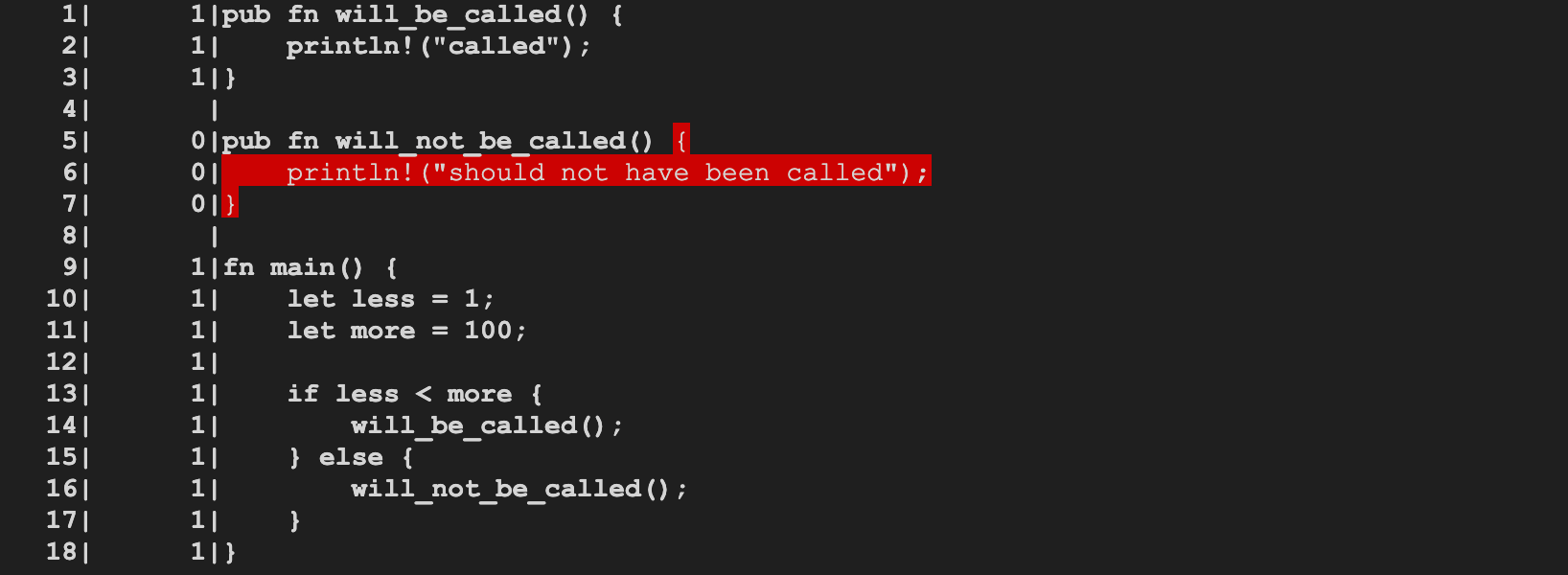
r? @wesleywiser
Rust compiler MCP rust-lang/compiler-team#278
Relevant issue: #34701 - Implement support for LLVMs code coverage instrumentation
|
|
Stop processing unreachable blocks when solving dataflow
...instead we `debug_assert` that the user is not checking the dataflow state for an unreachable block. This resolves a FIXME in the dataflow engine. The old behavior was an artifact of the previous dataflow framework. Things should run a tiny bit faster now, but I suspect not enough to show up in benchmarks. AFAIK, only the generator transform runs dataflow on MIR with unreachable basic blocks.
This PR also adds some utility methods to `mir::traversal`.
r? @pnkfelix
|
|
rustc now generates the coverage map and can support (limited)
coverage report generation, at the function level.
Example:
$ BUILD=$HOME/rust/build/x86_64-unknown-linux-gnu
$ $BUILD/stage1/bin/rustc -Zinstrument-coverage \
$HOME/rust/src/test/run-make-fulldeps/instrument-coverage/main.rs
$ LLVM_PROFILE_FILE="main.profraw" ./main
called
$ $BUILD/llvm/bin/llvm-profdata merge -sparse main.profraw -o main.profdata
$ $BUILD/llvm/bin/llvm-cov show --instr-profile=main.profdata main
1| 1|pub fn will_be_called() {
2| 1| println!("called");
3| 1|}
4| |
5| 0|pub fn will_not_be_called() {
6| 0| println!("should not have been called");
7| 0|}
8| |
9| 1|fn main() {
10| 1| let less = 1;
11| 1| let more = 100;
12| 1|
13| 1| if less < more {
14| 1| will_be_called();
15| 1| } else {
16| 1| will_not_be_called();
17| 1| }
18| 1|}
|
|
|
|
This replaces the need for the `description` and `details` symbols in
`UnsafetyViolation`, which are static. As a result some
`Symbol::as_str()` calls are no longer necessary, which is nice.
|
|
|
|
|
|
Support const args in type dependent paths (Take 2)
once more, except it is sound this time :smiling_face_with_three_hearts: previously #71154
-----
```rust
#![feature(const_generics)]
struct A;
impl A {
fn foo<const N: usize>(&self) -> usize { N }
}
struct B;
impl B {
fn foo<const N: usize>(&self) -> usize { 42 }
}
fn main() {
let a = A;
a.foo::<7>();
}
```
When calling `type_of` for generic const arguments, we now use the `TypeckTables` of the surrounding body to get the expected type.
This alone causes cycle errors though, as we now have `typeck_tables_of(main)` -> `...` ->
`type_of(main_ANON0 := 7)` -> `typeck_tables_of(main)` :zap: (see https://github.com/rust-lang/rust/issues/68400#issuecomment-611760290)
To prevent this we must not call `type_of(const_arg)` during `typeck_tables_of`. This is achieved by
calling `type_of(param_def_id)` instead.
We have to somehow remember the `DefId` of the param through all of typeck, which is done using the
struct `ty::WithOptConstParam<DefId>`, which replaces `DefId` where needed and contains an `Option<DefId>` to
be able to store the const parameter in case it exists.
Queries which are currently cached on disk are split into two variants: `query_name`(cached) and `query_name_(of|for)_const_arg`(not cached), with `query_name_of_const_arg` taking a pair `(did, param_did): (LocalDefId, DefId)`.
For some queries a method `query_name_of_opt_const_arg` is added to `TyCtxt` which takes a `ty::WithOptConstParam` and either calls `query_name` or `query_name_of_const_arg` depending on the value of `const_param_did`.
r? @eddyb @varkor
|
|
|
|
|
|
|
