| Age | Commit message (Collapse) | Author | Lines |
|---|
|
|
|
|
|
|
|
|
|
Previously, we were too conservative and `x.field = 4` was treated as a
"use" of `x`.
|
|
|
|
|
|
|
|
|
|
|
|
The generator transform needs to inspect all possible dataflow states.
This can be done with half the number of bitset union operations if we
can assume that the relevant analyses do not use "before" effects.
|
|
|
|
|
|
|
|
Remove old `util/liveness.rs` module
The liveness dataflow analysis now lives in the `dataflow` module, so this one is no longer necessary. I've copied the relevant bits of the module docs for `util::liveness` to `MaybeLiveLocals`. The example in the docs is now a `mir-dataflow` test: https://github.com/rust-lang/rust/blob/a08c47310c7d49cbdc5d7afb38408ba519967ecd/src/test/ui/mir-dataflow/liveness-ptr.rs#L6-L26
The borrow-checker used the same notion of "defs" and "uses", so I've moved it into a submodule. I would have moved it to `util/def_use.rs`, since it seems generally useful, but there's already a slightly [different version](https://github.com/rust-lang/rust/blob/master/src/librustc_mir/util/def_use.rs) of the same abstraction needed for copy propagation.
|
|
|
|
|
|
|
|
|
|
|
|
Before, it ignored the first argument and marked all variables without
`Storage*` annotations as dead.
|
|
|
|
|
|
|
|
|
|
(clippy::single_match)
Makes code more compact and reduces nestig.
|
|
|
|
|
|
|
|
|
|
Rename asm! to llvm_asm!
As per https://github.com/rust-lang/rfcs/pull/2843, this PR renames `asm!` to `llvm_asm!`. It also renames the compiler's internal `InlineAsm` data structures to `LlvmInlineAsm` in preparation for the new `asm!` functionality specified in https://github.com/rust-lang/rfcs/pull/2850.
This PR doesn't actually deprecate `asm!` yet, it just makes it redirect to `llvm_asm!`. This is necessary because we first need to update the submodules (in particular stdarch) to use `llvm_asm!`.
|
|
|
|
asm! is left as a wrapper around llvm_asm! to maintain compatibility.
|
|
We now have a way to apply an effect only *after* a `yield` resumes,
similar to calls (which can either return or unwind).
|
|
Use new dataflow framework for generators
#65672 introduced a new dataflow framework that can handle arbitrarily complex transfer functions as well as ones expressed as a series of gen/kill operations. This PR ports the analyses used to implement generators to the new framework so that we can remove the old one. See #68241 for a prior example of this. The new framework has some superficial API changes, but this shouldn't alter the generator passes in any way.
r? @tmandry
|
|
|
|
...to be consistent with the naming of other dataflow analyses.
|
|
|
|
|
|
Mark other variants as uninitialized after switch on discriminant
During drop elaboration, which builds the drop ladder that handles destruction during stack unwinding, we attempt to remove MIR `Drop` terminators that will never be reached in practice. This reduces the number of basic blocks that are passed to LLVM, which should improve performance. In #66753, a user pointed out that unreachable `Drop` terminators are common in functions like `Option::unwrap`, which move out of an `enum`. While discussing possible remedies for that issue, @eddyb suggested moving const-checking after drop elaboration. This would allow the former, which looks for `Drop` terminators and replicates a small amount of drop elaboration to determine whether a dropped local has been moved out, leverage the work done by the latter.
However, it turns out that drop elaboration is not as precise as it could be when it comes to eliminating useless drop terminators. For example, let's look at the code for `unwrap_or`.
```rust
fn unwrap_or<T>(opt: Option<T>, default: T) -> T {
match opt {
Some(inner) => inner,
None => default,
}
}
```
`opt` never needs to be dropped, since it is either moved out of (if it is `Some`) or has no drop glue (if it is `None`), and `default` only needs to be dropped if `opt` is `Some`. This is not reflected in the MIR we currently pass to codegen.
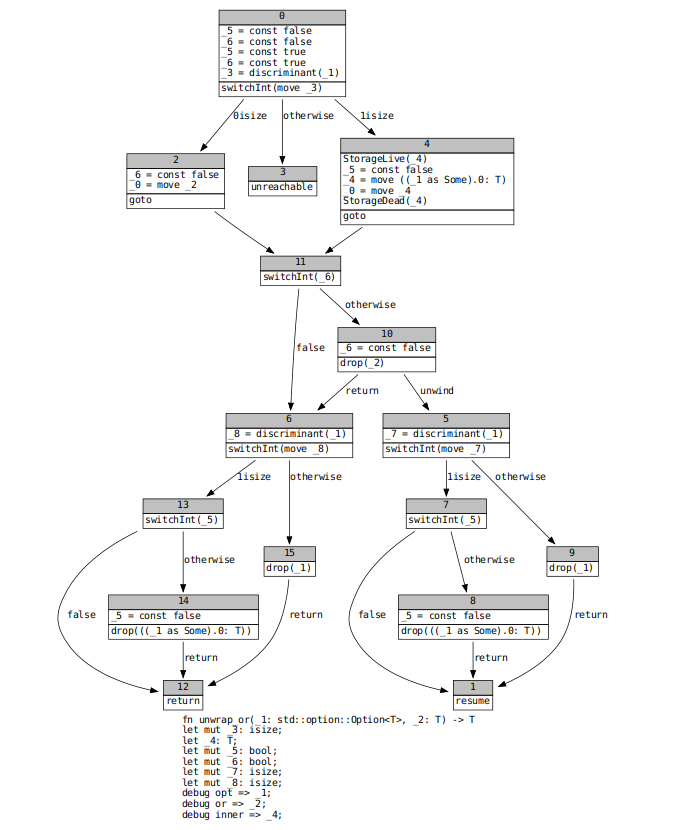
@eddyb also suggested the solution to this problem. When we switch on an enum discriminant, we should be marking all fields in other variants as definitely uninitialized. I implemented this on top of alongside a small optimization (split out into #68943) that suppresses drop terminators for enum variants with no fields (e.g. `Option::None`). This is the resulting MIR for `unwrap_or`.
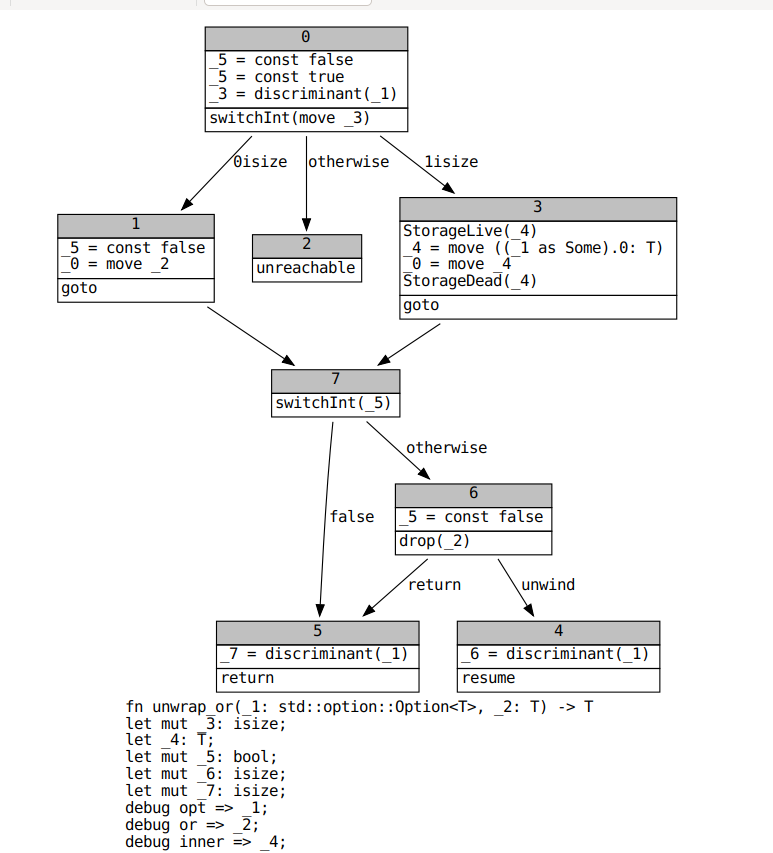
In concert with #68943, this change speeds up many [optimized and debug builds](https://perf.rust-lang.org/compare.html?start=d55f3e9f1da631c636b54a7c22c1caccbe4bf0db&end=0077a7aa11ebc2462851676f9f464d5221b17d6a). We need to carefully investigate whether I have introduced any miscompilations before merging this. Code that never drops anything would be very fast indeed until memory is exhausted.
|
|
|
|
|
|
|
|
|
|
|
|
|
|
|
|
|
|
It should have the same semantics as `HaveBeenBorrowedLocals`
|
|
`MaybeMutBorrowedLocals` serves the same purpose and has a better name.
|
