| Age | Commit message (Collapse) | Author | Lines |
|---|
|
|
|
|
|
|
|
|
|
Fix #[thread_local] statics as asm! sym operands
The `asm!` RFC specifies that `#[thread_local]` statics may be used as `sym` operands for inline assembly.
This also fixes a regression in the handling of `#[thread_local]` during monomorphization which caused link-time errors with multiple codegen units, most likely introduced by #71192.
r? @oli-obk
|
|
Fixes #69977
When we parse a chain of method calls like `foo.a().b().c()`, each
`MethodCallExpr` gets assigned a span that starts at the beginning of
the call chain (`foo`). While this is useful for diagnostics, it means
that `Location::caller` will return the same location for every call
in a call chain.
This PR makes us separately record the span of the function name and
arguments for a method call (e.g. `b()` in `foo.a().b().c()`). This
`Span` is passed through HIR lowering and MIR building to
`TerminatorKind::Call`, where it is used in preference to
`Terminator.source_info.span` when determining `Location::caller`.
This new span is also useful for diagnostics where we want to emphasize
a particular method call - for an example, see
https://github.com/rust-lang/rust/pull/72389#discussion_r436035990
|
|
|
|
|
|
|
|
This reverts commit 54aa418a6082b364b90feee70b07381ea266c4d5.
|
|
This reverts commit b998497bd41d6de71ec035433247dee856d1f3a5.
|
|
Make TLS accesses explicit in MIR
r? @rust-lang/wg-mir-opt
cc @RalfJung @vakaras for miri thread locals
cc @bjorn3 for cranelift
fixes #70685
|
|
|
|
|
|
|
|
|
|
|
|
|
|
|
|
|
|
|
|
(clippy::single_match)
Makes code more compact and reduces nestig.
|
|
|
|
|
|
asm! is left as a wrapper around llvm_asm! to maintain compatibility.
|
|
(clippy::let_and_return)
|
|
Make PlaceRef take just one lifetime
r? @eddyb
|
|
|
|
|
|
|
|
Mark other variants as uninitialized after switch on discriminant
During drop elaboration, which builds the drop ladder that handles destruction during stack unwinding, we attempt to remove MIR `Drop` terminators that will never be reached in practice. This reduces the number of basic blocks that are passed to LLVM, which should improve performance. In #66753, a user pointed out that unreachable `Drop` terminators are common in functions like `Option::unwrap`, which move out of an `enum`. While discussing possible remedies for that issue, @eddyb suggested moving const-checking after drop elaboration. This would allow the former, which looks for `Drop` terminators and replicates a small amount of drop elaboration to determine whether a dropped local has been moved out, leverage the work done by the latter.
However, it turns out that drop elaboration is not as precise as it could be when it comes to eliminating useless drop terminators. For example, let's look at the code for `unwrap_or`.
```rust
fn unwrap_or<T>(opt: Option<T>, default: T) -> T {
match opt {
Some(inner) => inner,
None => default,
}
}
```
`opt` never needs to be dropped, since it is either moved out of (if it is `Some`) or has no drop glue (if it is `None`), and `default` only needs to be dropped if `opt` is `Some`. This is not reflected in the MIR we currently pass to codegen.
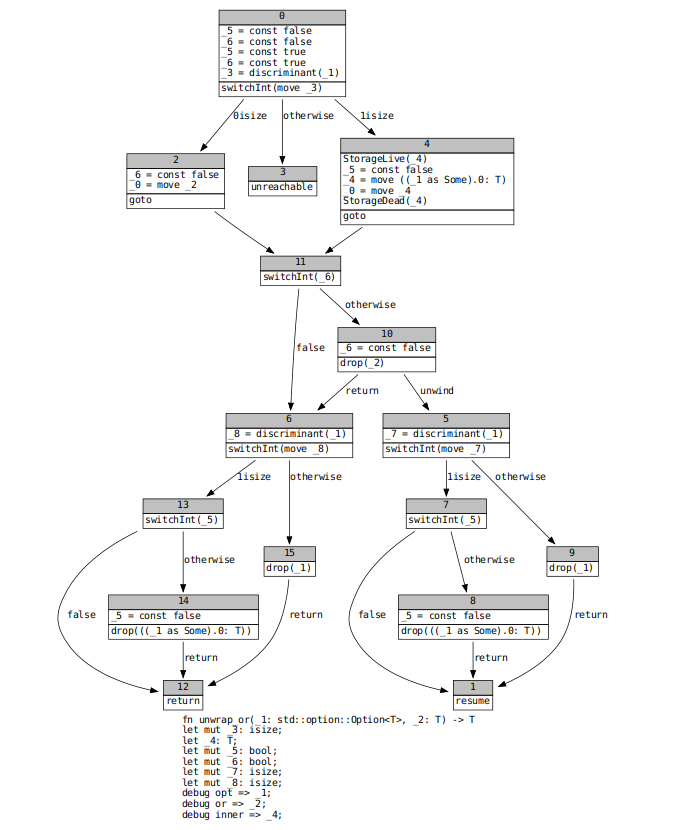
@eddyb also suggested the solution to this problem. When we switch on an enum discriminant, we should be marking all fields in other variants as definitely uninitialized. I implemented this on top of alongside a small optimization (split out into #68943) that suppresses drop terminators for enum variants with no fields (e.g. `Option::None`). This is the resulting MIR for `unwrap_or`.
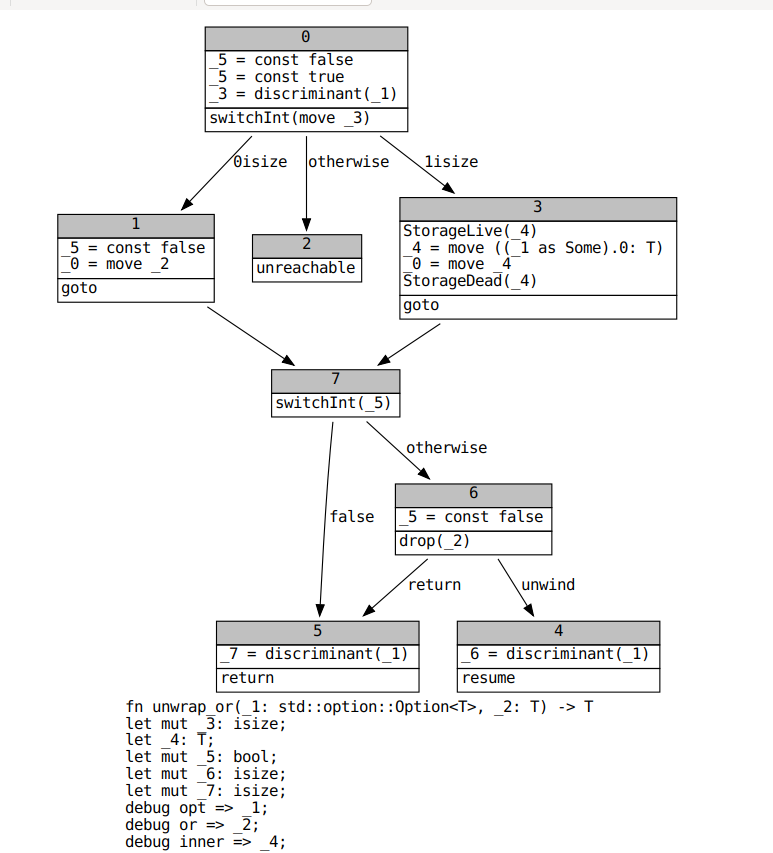
In concert with #68943, this change speeds up many [optimized and debug builds](https://perf.rust-lang.org/compare.html?start=d55f3e9f1da631c636b54a7c22c1caccbe4bf0db&end=0077a7aa11ebc2462851676f9f464d5221b17d6a). We need to carefully investigate whether I have introduced any miscompilations before merging this. Code that never drops anything would be very fast indeed until memory is exhausted.
|
|
|
|
|
|
|
|
|
|
|
|
|
|
|
|
|
|
|
|
Also add unit tests
|
|
|
|
|
|
|
|
Don't suppress move errors for union fields
closes #66500
|
|
|
|
This operator creates a raw pointer to a Place directly, without first
creating a reference. See RFC #2582 for motivation.
The Rvalue is currently unused.
|
|
These passes were buggy, MIR building is now responsible for
canonicalizing `ConstantIndex` projections and `MoveData` is responsible
for splitting `Subslice` projections.
|
|
* `min_length` is now exact for const index elements.
* const index elements are always from the start.
* make array `Subslice` `PlaceElems` count both `from` and `to` from the
start.
|
|
|
