| Age | Commit message (Collapse) | Author | Lines |
|---|
|
|
|
The change to `impl Clean<Path> for hir::TraitRef<'_>` was necessary to
fix a test failure for `src/test/rustdoc/trait-alias-mention.rs`.
Here's why:
The old code path was through `impl Clean<Type> for hir::TraitRef<'_>`,
which called `resolve_type`, which in turn called `register_res`. Now,
because `PolyTrait` uses a `Path` instead of a `Type`, the impl of
`Clean<Path>` was being run, which did not call `register_res`, causing
the trait alias to not be recorded in the `external_paths` cache.
|
|
|
|
(clippy::useless_conversion)
Example:
let _x: String = String::from("hello world").into();
|
|
This commit adds a test case for generics, re-adds generics data
to the search index, and tweaks function indexing to use less space in JSON.
This reverts commit 14ca89446c076bcf484d3d05bd991a4b7985a409.
|
|
Properly render HRTBs
```rust
pub fn test<T>()
where
for<'a> &'a T: Iterator,
{}
```
This will now render properly including the `for<'a>`

I do not know if this covers all cases, it only covers everything that I could think of that includes `for` and lifetimes in where bounds.
Also someone need to mentor me on how to add a proper rustdoc test for this.
Resolves #78482
|
|
Commit e629381653bb3579f0cea0b256e391edef5e8dbb removes the only place
these members variables are actually read.
|
|
objects
|
|
Before:

After:
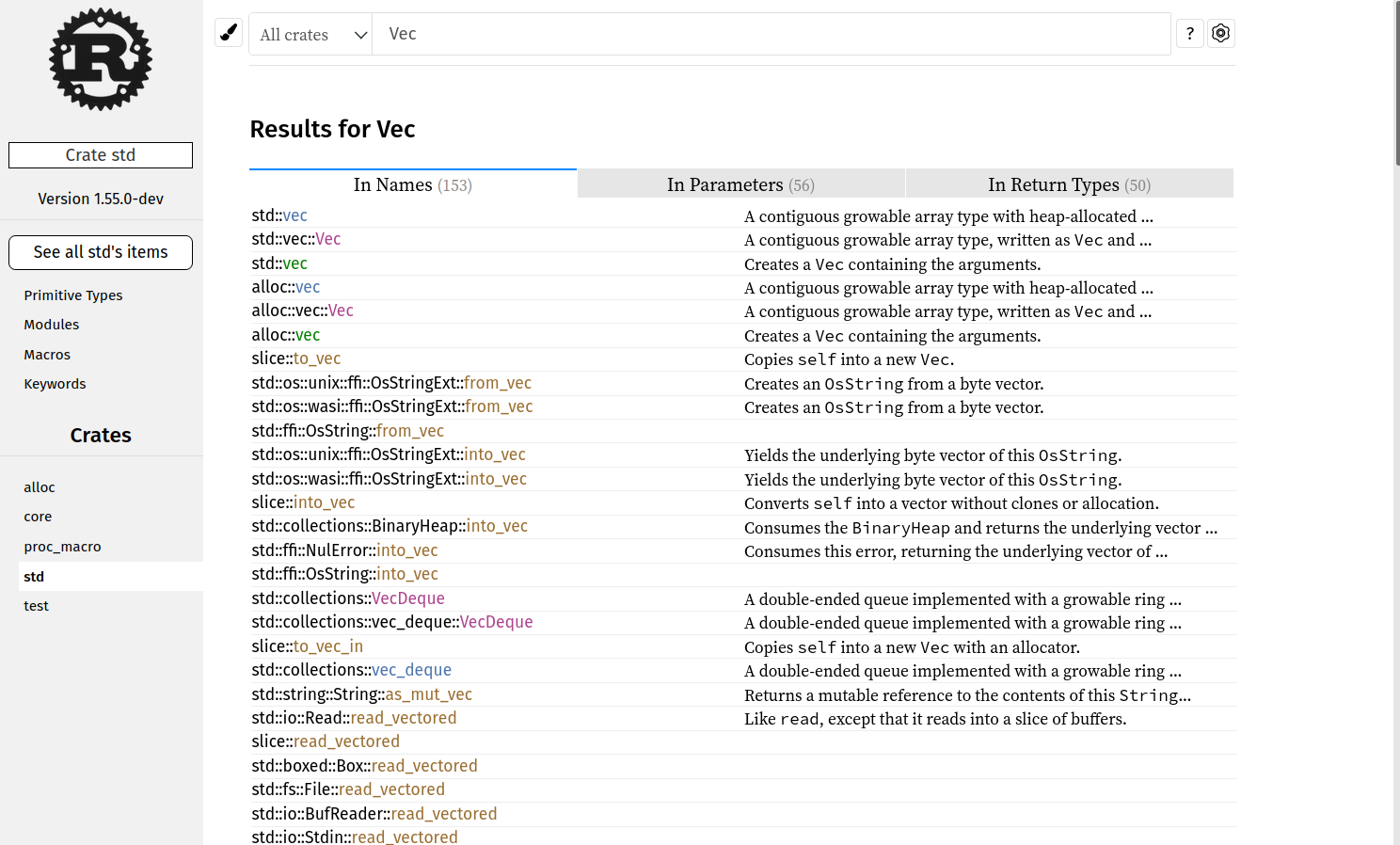
|
|
|
|
|
|
extern_location function
|
|
check item.is_fake() instead of self_id.is_some()
Remove empty branching in Attributes::from_ast
diverse small refacto after Josha review
cfg computation moved in merge_attrs
refacto use from_ast twice for coherence
take cfg out of Attributes and move it to Item
|
|
the fields in Attributes, as functions in AttributesExt.
refacto use from_def_id_and_attrs_and_parts instead of an old trick
most of josha suggestions + check if def_id is not fake before using it in a query
Removed usage of Attributes in FnDecl and ExternalCrate. Relocate part of the Attributes fields as functions in AttributesExt.
|
|
|
|
|
|
|
|
This should not affect the appearance of the docs pages themselves.
This makes the pre-compressed search index smaller, thanks to the
empty-string path duplication format, and also the gzipped version,
by giving the algorithm more structure to work with.
rust$ wc -c search-index-old.js search-index-new.js
2628334 search-index-old.js
2586181 search-index-new.js
5214515 total
rust$ gzip search-index-*
rust$ wc -c search-index-old.js.gz search-index-new.js.gz
239486 search-index-old.js.gz
237386 search-index-new.js.gz
476872 total
|
|
I'm wondering if it was originally there so that we could `take` the
module which enables `after_krate` to take an `&Crate`. However, the two
impls of `after_krate` only use `Crate.name`, so we can pass just the
name instead.
|
|
This essentially switches search-index.js from a "array of struct"
to a "struct of array" format, like this:
{
"doc": "Crate documentation",
"t": [ 1, 1, 2, 3, ... ],
"n": [ "Something", "SomethingElse", "whatever", "do_stuff", ... ],
"q": [ "a::b", "", "", "", ... ],
"d": [ "A Struct That Does Something", "Another Struct", "a function", "another function", ... ],
"i": [ 0, 0, 1, 1, ... ],
"f": [ null, null, [], [], ... ],
"p": ...,
"a": ...
}
So `{ty: 1, name: "Something", path: "a::b", desc: "A Struct That Does Something", parent_idx: 0, search_type: null}` is the first item.
This makes the uncompressed version smaller, but it really shows on the
compressed version:
notriddle:rust$ wc -c new-search-index1.52.0.js
2622427 new-search-index1.52.0.js
notriddle:rust$ wc -c old-search-index1.52.0.js
2725046 old-search-index1.52.0.js
notriddle:rust$ gzip new-search-index1.52.0.js
notriddle:rust$ gzip old-search-index1.52.0.js
notriddle:rust$ wc -c new-search-index1.52.0.js.gz
239385 new-search-index1.52.0.js.gz
notriddle:rust$ wc -c old-search-index1.52.0.js.gz
296328 old-search-index1.52.0.js.gz
notriddle:rust$
That's a 4% improvement on the uncompressed version (fewer `[]`),
and 20% improvement after gzipping it, thanks to putting like-typed
data next to each other. Any compression algorithm based on a sliding
window will probably show this kind of improvement.
|
|
|
|
|
|
|
|
|
|
r=poliorcetics,CraftSpider
Bind all clean::Type variants and remove FIXME
This is simply a little cleanup.
cc `@CraftSpider`
r? `@poliorcetics`
|
|
|
|
|
|
|
|
|
|
|
|
|
|
This brings the size of `Item` from
```
[src/librustdoc/lib.rs:103] std::mem::size_of::<Item>() = 680
```
to
```
[src/librustdoc/lib.rs:103] std::mem::size_of::<Item>() = 280
```
|
|
Continue String to Symbol conversion in rustdoc
Follow-up of https://github.com/rust-lang/rust/pull/80091.
This PR is already big enough so I'll stop here before the next one.
r? `@jyn514`
|
|
|
|
Use more symbols in rustdoc
Builds on https://github.com/rust-lang/rust/pull/80044 and should not be merged before.
I want to test if this is actually faster before merging it, there was a lot of `to_string()` calls so I'm not sure it will actually help. That means I have to wait for 80044 to get merged before running perf.
r? `@ghost`
|
|
|
|
|
|
This decreases the size of `Item` from 680 to 616 bytes. It also does a
lot less work since it no longer has to copy as much.
|
|
Previously Markdown documentation was not rendered to HTML for search results,
which led to the output not being very readable, particularly for inline code.
This PR fixes that by rendering Markdown to HTML with the help of pulldown-cmark
(the library rustdoc uses to parse Markdown for the main text of documentation).
However, the text for the title attribute (the text shown when you hover over an
element) still uses the plain-text rendering since it is displayed in browsers
as plain-text.
Only these styles will be rendered; everything else is stripped away:
* *italics*
* **bold**
* `inline code`
|
|
Replace it instead with `(clean::Function, Option<hir::Defaultness>)`.
|
|
This gives warnings about dead code.
|
|
|
|
The discussion seems to have resolved that this lint is a bit "noisy" in
that applying it in all places would result in a reduction in
readability.
A few of the trivial functions (like `Path::new`) are fine to leave
outside of closures.
The general rule seems to be that anything that is obviously an
allocation (`Box`, `Vec`, `vec![]`) should be in a closure, even if it
is a 0-sized allocation.
|
|
Fixes #38386.
Fixes #48332.
Fixes #49430.
Fixes #62741.
Fixes #73474.
|
|
|
|
For consistency with `Attribute::has_name` which doesn't mark the attribute as used either.
Replace all uses of `check_name` with `has_name` outside of rustc
|
|
|
|
|
|
- Pass around document_private a lot more
- Add tests
+ Add tests for intra-doc links to private items
+ Add ignored tests for warnings in reference links
|
|
Such splits arise from metadata refs into libstd.
This way, we can (in a follow on commit) continue to emit the virtual name into
things like the like the StableSourceFileId that ends up in incremetnal build
artifacts, while still using the devirtualized file path when we want to access
the file.
Note that this commit is intended to be a refactoring; the actual fix to the bug
in question is in a follow-on commit.
|
