| Age | Commit message (Collapse) | Author | Lines |
|---|
|
|
|
When running tests inside the Android emulator, bootstrap doesn't set
the TEST_DEVICE_ADDR environment variable, as the default address
(127.0.0.1:12345) is used.
Instead, REMOTE_TEST_CLIENT is set all the times when remote testing is
needed, and in no other cases. To ensure Android tests are executed in
the emulator, change the check.
|
|
|
|
|
|
|
|
|
|
This fixes warning when building Rust and running tests:
```
warning: library kind `static-nobundle` has been superseded by specifying `-bundle` on library kind `static`. Try `static:-bundle`
warning: `rustc_llvm` (lib) generated 2 warnings (1 duplicate)
```
|
|
|
|
Calling an executable via full path with Windows backslashes fails in
dash.
|
|
|
|
Updates `tools.mk` to explicitly require `SHELL := /bin/dash`, since CI
uses `dash` but other environments (including developer local machines)
may default to `bash`.
Replaces bash-specific shell command in one Makefile with a
dash-compatible alternative, and re-enables the affected Makefile test.
Removes apparently redundant definition of `UNAME`.
|
|
|
|
MinGW: enable dllexport/dllimport
Fixes (only when using LLD) https://github.com/rust-lang/rust/issues/50176
Fixes https://github.com/rust-lang/rust/issues/72319
This makes `windows-gnu` on pair with `windows-msvc` when it comes to symbol exporting.
For MinGW it means both good things like correctly working dllimport/dllexport, ability to link with LLD and bad things like https://github.com/rust-lang/rust/issues/27438.
Not sure but maybe this should land behind unstable compiler option (`-Z`) or environment variable?
|
|
|
|
Generating the coverage map
@tmandry @wesleywiser
rustc now generates the coverage map and can support (limited)
coverage report generation, at the function level.
Example commands to generate a coverage report:
```shell
$ BUILD=$HOME/rust/build/x86_64-unknown-linux-gnu
$ $BUILD/stage1/bin/rustc -Zinstrument-coverage \
$HOME/rust/src/test/run-make-fulldeps/instrument-coverage/main.rs
$ LLVM_PROFILE_FILE="main.profraw" ./main
called
$ $BUILD/llvm/bin/llvm-profdata merge -sparse main.profraw -o main.profdata
$ $BUILD/llvm/bin/llvm-cov show --instr-profile=main.profdata main
```
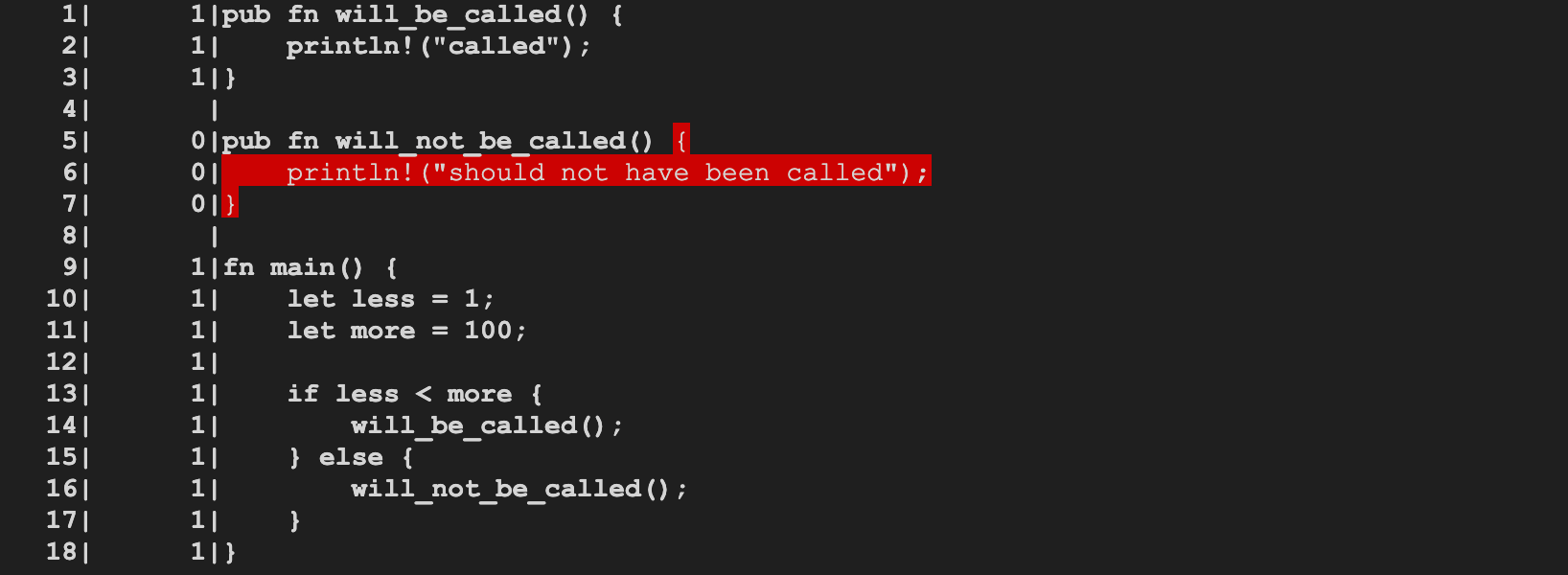
r? @wesleywiser
Rust compiler MCP rust-lang/compiler-team#278
Relevant issue: #34701 - Implement support for LLVMs code coverage instrumentation
|
|
rustc now generates the coverage map and can support (limited)
coverage report generation, at the function level.
Example:
$ BUILD=$HOME/rust/build/x86_64-unknown-linux-gnu
$ $BUILD/stage1/bin/rustc -Zinstrument-coverage \
$HOME/rust/src/test/run-make-fulldeps/instrument-coverage/main.rs
$ LLVM_PROFILE_FILE="main.profraw" ./main
called
$ $BUILD/llvm/bin/llvm-profdata merge -sparse main.profraw -o main.profdata
$ $BUILD/llvm/bin/llvm-cov show --instr-profile=main.profdata main
1| 1|pub fn will_be_called() {
2| 1| println!("called");
3| 1|}
4| |
5| 0|pub fn will_not_be_called() {
6| 0| println!("should not have been called");
7| 0|}
8| |
9| 1|fn main() {
10| 1| let less = 1;
11| 1| let more = 100;
12| 1|
13| 1| if less < more {
14| 1| will_be_called();
15| 1| } else {
16| 1| will_not_be_called();
17| 1| }
18| 1|}
|
|
|
|
|
|
|
|
|
|
|
|
|
|
|
|
use the code generation parameter -Clinker (same parameter as rustc)
to control what linker to use for building the rustdoc test executables.
closes: #63816
|
|
|
|
|
|
|
|
This still expectedly fails for musl targets with +crt-static.
|
|
This reverts commit bd94bf5738c7a0fd148157831eabd1efede3b309.
|
|
|
|
This commit is an implementation of adding custom sections to wasm artifacts in
rustc. The intention here is to expose the ability of the wasm binary format to
contain custom sections with arbitrary user-defined data. Currently neither our
version of LLVM nor LLD supports this so the implementation is currently custom
to rustc itself.
The implementation here is to attach a `#[wasm_custom_section = "foo"]`
attribute to any `const` which has a type like `[u8; N]`. Other types of
constants aren't supported yet but may be added one day! This should hopefully
be enough to get off the ground with *some* custom section support.
The current semantics are that any constant tagged with `#[wasm_custom_section]`
section will be *appended* to the corresponding section in the final output wasm
artifact (and this affects dependencies linked in as well, not just the final
crate). This means that whatever is interpreting the contents must be able to
interpret binary-concatenated sections (or each constant needs to be in its own
custom section).
To test this change the existing `run-make` test suite was moved to a
`run-make-fulldeps` folder and a new `run-make` test suite was added which
applies to all targets by default. This test suite currently only has one test
which only runs for the wasm target (using a node.js script to use `WebAssembly`
in JS to parse the wasm output).
|
